
Centering nourishment at The Humanities Institute
The Humanities Institute (THI) at UC Santa Cruz is exploring the theme of nourishment this year, inviting the campus and community to reflect on what sustains life, fosters connection, and makes flourishing possible. “What does it mean to be nourished in our bodies, our minds and our communities at a moment of profound social, political, and ecological change?” said Saskia Nauenberg Dunkell, research programs and communications director for THI.
By Dan White
The Humanities Institute (THI) at UC Santa Cruz is exploring the theme of nourishment this year, inviting the campus and community to reflect on what sustains life, fosters connection, and makes flourishing possible.
“What does it mean to be nourished in our bodies, our minds and our communities at a moment of profound social, political, and ecological change?” said Saskia Nauenberg Dunkell, research programs and communications director for THI.
In panel discussions, high-profile events and research clusters, THI, a hub for cross-disciplinary humanities research and collaboration, approaches nourishment broadly, encompassing food, care, imagination, intellectual renewal and ethical responsibility.
Across its programs, THI is examining how individuals and communities are sustained physically, relationally, intellectually and ecologically.
“Nourishment calls us not simply to sustain ourselves but to flourish,” said Linguistics Professor and THI faculty director Pranav Anand. “One of the preeminent powers of the humanities is the ability to move us — to displace us from our present selves and to activate our emotions. We hope this theme opens opportunities for care, refuge, delight, connection, purpose and joy.”
Anand noted that the theme reflects both campus research and global conditions. “We chose nourishment in December 2024, on the heels of a tumultuous U.S. presidential election season and amid widespread global devastation,” he said.
A centerpiece of THI’s public programming is the annual Deep Read. This year’s event features biologist and author Merlin Sheldrake, who will speak May 31 about Entangled Life: How Fungi Make Our World, Change Our Minds, and Shape Our Futures.
“Entangled Life reveals the foundational and nourishing role of fungal webs in our world,” said Laura Martin, research programs manager at THI. “Together, we’ll explore the dependence of all life — human, plant, animal and beyond — on fungal networks, and how those interconnections challenge our understanding of existence, identity and intelligence.”
Celebrating sustainable food systems
Foodways and sustainability anchor several major events this year. In October, THI partnered with Bookshop Santa Cruz to host chef and author Alice Waters at the Rio Theatre. Waters, founder and owner of Chez Panisse restaurant in Berkeley, discussed her decades-long efforts to transform school food systems by connecting students with local growers and seasonal ingredients, emphasizing cultivation as an educational and civic practice.
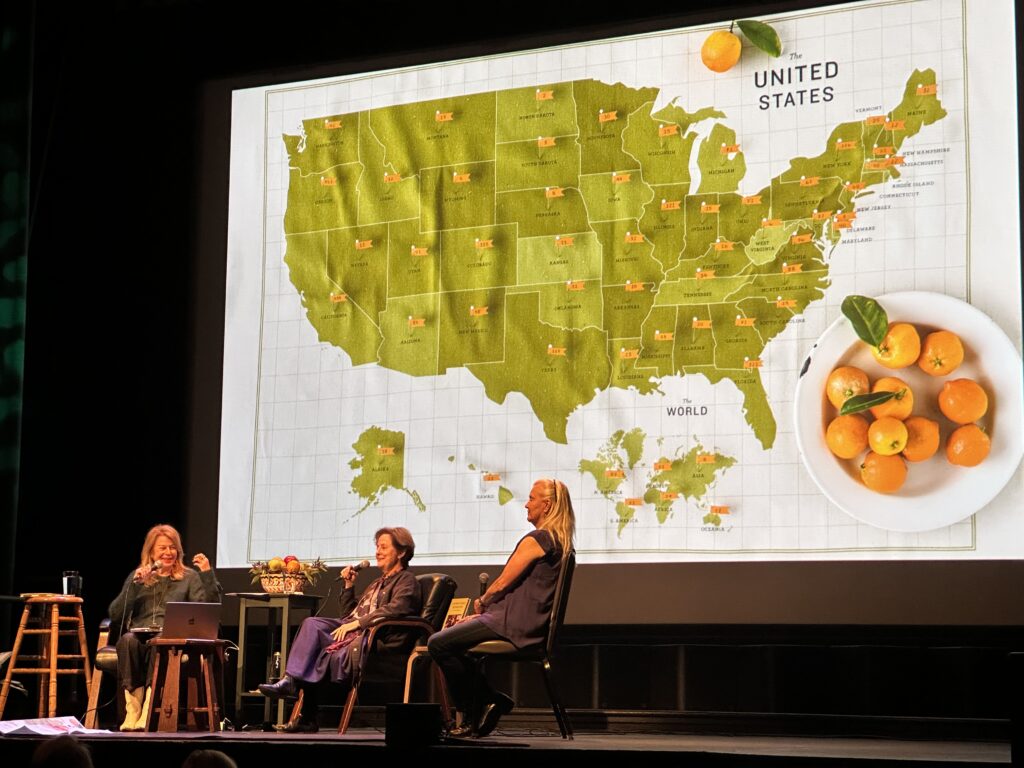
On Feb. 12, THI will host nutritionist and consumer advocate Marion Nestle for the annual Peggy Downes Baskin Ethics Lecture. Her talk, “Sustainable Food in the Trump Era,” will address food politics, sustainable agriculture and nutrition science in light of recent changes to federal dietary guidelines affecting schools, the military and food assistance programs.
Anand said Nestle’s perspective is especially urgent as food policy shifts carry wide-ranging social and ethical consequences. In a recent editorial, Nestle criticized the guidelines for emphasizing personal responsibility over public health policy, arguing that they place the burden on individuals to “eat real food” while navigating a food system structured to maximize corporate profit rather than health.
Nestle also faulted the guidelines for overlooking social and economic barriers — including income, education, access to grocery stores and safe cooking spaces — that limit many people’s ability to make healthy choices.
The Center for South Asian Studies (CSAS) and the Center for the Middle East and North Africa (CMENA), both housed at THI, are also leading food-related programming. CSAS has examined the historical and ecological legacies of plantation agriculture in Southeast Asia, while CMENA will screen Couscous: The Seeds of Dignity, a documentary focused on food sovereignty and heirloom seed preservation this spring.
Alongside these public events, THI is supporting three research clusters that study different dimensions of nourishment through collaborative interdisciplinary humanities scholarship.
This includes Seeds of Resurgence, which examines heirloom seeds as carriers of ancestral knowledge and resistance to colonial agricultural systems, The Palestine Lab, which explores nourishment through land, memory and food sovereignty under conditions of dispossession, and the More-Than-Human(ities) Laboratory, which embraces composting as a practice and metaphor to examine renewal, collaboration and intellectual regeneration across disciplines.
Relational nourishment and the importance of caregiving
Nourishment also shapes THI’s focus on caregiving, disability and interdependence. On Jan. 20, the institute will host Nurturing Difference: Parenting and Disability in a Careless Age at the Cowell Ranch Hay Barn.
A faculty panel will discuss Professor Emerita of Anthropology Danilyn Rutherford’s book Beautiful Mystery: Living in a Wordless World and Professor of Computational Media Noah Wardrip-Fruin’s book Animal Crossing: New Horizons — Can a Game Take Care of Us?
In Beautiful Mystery, Rutherford reflects on raising her daughter, Millie, who has high assistance needs, and on the web of caregivers who sustain and enrich their lives. Wardrip-Fruin’s book examines parenting and care during the early months of the COVID-19 pandemic through the lens of a popular video game.
They will be joined by Professor Emerita of History of Consciousness Donna Haraway and Professor of Anthropology Megan Moodie, chair of the Disabled Faculty Networking Group and a core member of the disability studies initiative on campus.
Anand, who will moderate the panel, said care-centered disability perspectives offer critical insights into sustaining life amid social and material precarity.
“These two deeply beautiful meditations invite us to reflect on the connections that sustain those we care for,” Anand said. “Their disability-centered narratives force us to contend with the indifference and cruelty of a one-size-fits-all world, and reveal how love and relational care can mend it.”
Together, THI’s programs will position nourishment as both a subject of study and a guiding ethic.
Through food systems, caregiving, environmental networks and collaborative scholarship, the institute’s work this year asks how the humanities can help sustain life, cultivate responsibility and imagine more just and flourishing futures — on campus and beyond.
Original Link: https://news.ucsc.edu/2026/01/centering-nourishment-at-the-humanities-institute/