
Fellow’s Report: Brian Kantor
Brian Kantor is a PhD student in the History of Consciousness department and a 2025 THI Moving Image Lab Public Fellow working with the Isaac Julien Studio on a research and curatorial project funded by the Mellon Foundation. In this report from the field, he shares about his recent experience traveling to Italy for the opening of Isaac Julien’s new film installation.
Giants, too, groan under the weight of the world. So I learned, at least, while recently gazing upon the rounded walls of Chamber of the Giants, a spacious and domed floor-to-ceiling fresco at Palazzo Te, a sixteenth-century villa in Mantua, Italy, that today houses major art exhibitions and cultural programs.
Created by Giulio Romano for the Duke of Mantua during the Palazzo’s construction, the panoramic fresco depicts a battle between Zeus and an onslaught of giants, a myth drawn from Ovid’s genre-defying narrative poem, Metamorphoses, about the mythological origins of the world.
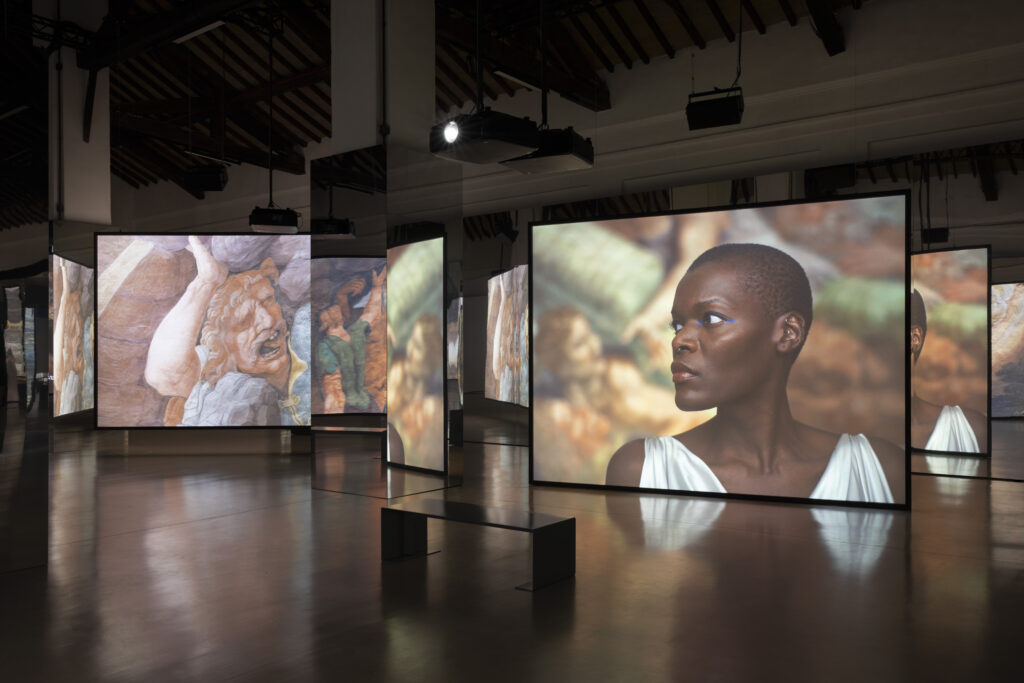
More recently, the chamber features prominently in UC Santa Cruz Distinguished Arts and History of Consciousness Professor Sir Isaac Julien’s latest film, All That Changes You. Metamorphosis, which showcases British actors Gwendoline Christie (Game of Thrones, Wednesday, and Severance) and Sheila Atim (All Dirt Roads Taste of Salt), and continues Julien’s innovative practice of multi-channel film installation.
The film had its world premiere on October 4th in the Palazzo Te’s Fruttiere wing, mere steps from the Chamber of the Giants. Just prior, I had the chance to visit the Palazzo as one of this year’s Isaac Julien Moving Image Lab Fellows for a pre-opening screening. For this event, held on a crisp evening as Mantua’s leaves had just begun to turn, I joined Julien and his partner and collaborator, Mark Nash, along with their Studio staff, THI’s Laura Martin, and other creative partners.
The pre-opening event celebrated not only the film but also the Palazzo Te itself. As the Palazzo’s Director, Stefano Baia Curioni, shared with us beneath stone columns and the evening’s crepuscular light, he and the Palazzo Te invited Julien to create his film to mark the palace’s 500th year, recognizing in Julien’s filmmaking a nuanced treatment of philosophy and time that, in many ways, overlaps with the Palazzo Te’s institutional ethos and concerns.
Prior to a celebratory banquet dinner, we visited the Fruttiere wing for a screening of All that Changes You. As we entered the modern, darkened hall with high ceilings, we were drawn to the mirrors that adorn both the perimeter of the room and a series of structural columns running down the center of the building. Reflective surfaces are everywhere present in the installation. Ten projector screens are arranged in an oblong diamond pattern, almost enclosing viewers in an immersive, performative experience in which they occupy the film’s installation space and are invited to create their own experience by selecting which screens to view and from where, choosing to sit on benches, to stand, or to walk throughout the installation.
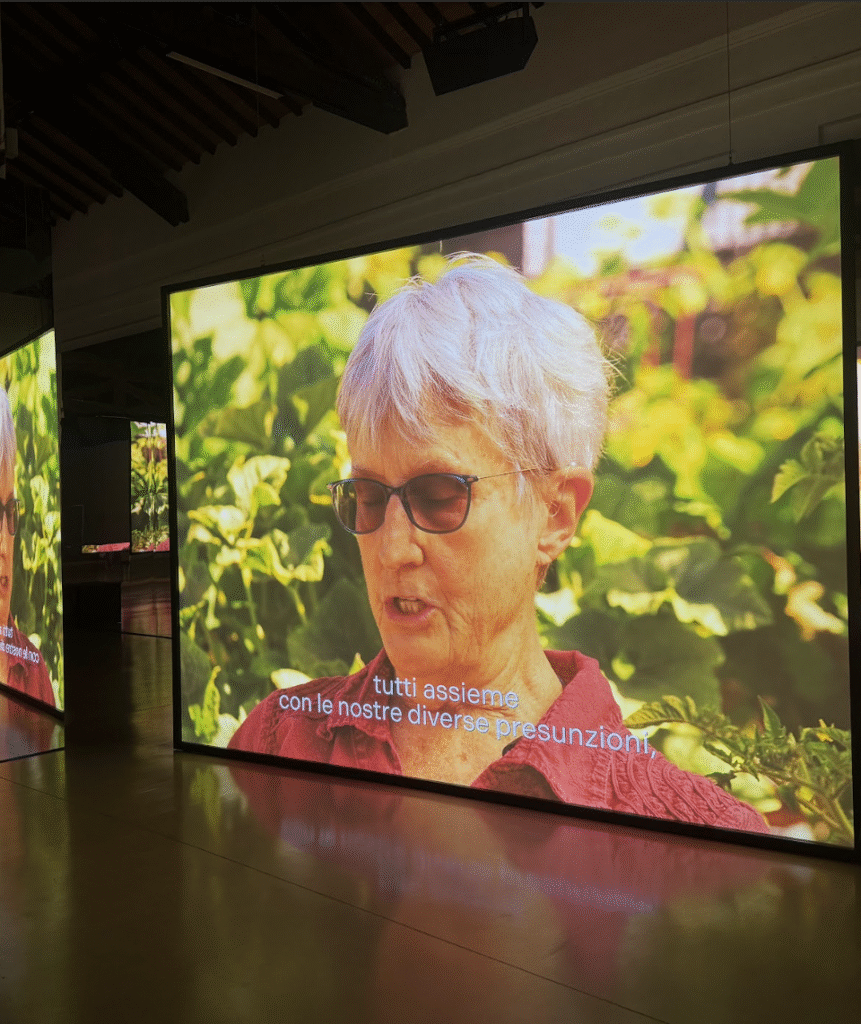
The film draws from various writers both scholarly and creative—UC Santa Cruz Professor Emerita Donna Haraway especially, in addition to Anna Tsing, Octavia Butler, and Naomi Mitchison—to meditate upon what it means to live amidst man-made crises. The film opens with Haraway, seated in a garden, reading from her 2016 book Staying with the Trouble and speaking about the etymology of trouble as it relates to her notion of resurgence and the art of living and dying well amidst a troubled present.
In addition to these philosophical meditations, the film’s imagery expresses a form of homage to Julien’s interlocutors in Santa Cruz and at the Palazzo Te. Julien filmed much of All that Changes You in both the forests of Santa Cruz and several historic rooms of the Palazzo Te, including the Chamber of the Giants, settings that visually register the film’s interest in ecology, anthropology, story, and time. Such settings also inspire Christie and Atim’s characters in the film who, clad in elegant and flowing fabric, appear as if animated out of the Palazzo’s very frescos.
As a THI Moving Image Lab Fellow working with the Isaac Julien Studio this quarter, the opening event was an exciting opportunity to participate in important conversations between artists, scholars, and cultural institutions, like the Palazzo Te. Based in London for the next few months, I will continue working in this milieu, especially with Mark Nash, fellow director of the Isaac Julien Studio and one of the developers of the film’s script. I will be working with him on a nascent curatorial project about film and art’s treatment of environmental crisis as well as its philosophical contemplation. This work complements my own research on visual culture and the history of documentary media, especially as it relates to the construction of time, historical narrative, and knowledge circulation.
Consternation over what has been, what is, and what will be is an enduring feature of what it means to be human. In that sense, spending a few days in Mantua and gazing upon the Chamber of the Giants was a fitting choice for our particular moment.
Looking upon the vibrant panorama, one notices scratches and graffiti that mars (or adds to) the fresco’s surfaces: The Palazzo Te has shifted possession over the years, from royal palace to military barracks to art institution, rendering its surfaces vulnerable to vandals eager to voice their own convictions about their place in the world. In that sense, Chamber of the Giants speaks to temporal continuity; the ongoingness of social, political, and environmental struggle; and Haraway’s challenge in Staying with the Trouble, of learning to “make kin” and live with one another in thick and complicated times.
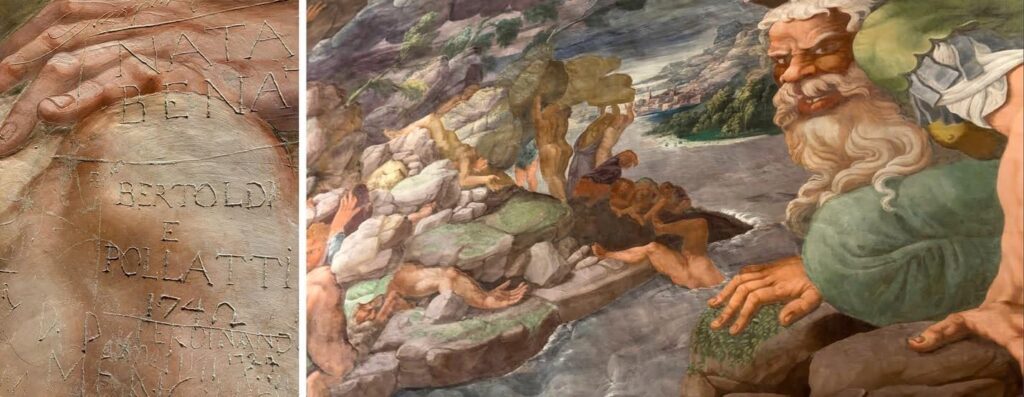
Details from the Chamber of the Giants fresco at the Palazzo Te. Photo credit: Brian Kantor.
Banner image and exhibition photos:
Installation view, Isaac Julien, All That Changes You. Metamorphosis, Palazzo Te, Mantova, 4 October 2025 – 01 February 2026
Credit line: Courtesy the artist, Victoria Miro and Jessica Silverman. © The artist.
Photo: Andrea Rossetti / Palazzo Te