
How corporations and politicians decide what you eat: a conversation with Marion Nestle
A few hours before delivering the Peggy Downes Baskin Ethics Lecture, the longtime nutrition scholar and tireless consumer advocate Marion Nestle gave a far-ranging, informal interview at The Humanities Institute (THI) Nestle discussed the political structure of the American food system, arguing that corporate influence—from agricultural subsidies to supermarket slotting fees—shapes what people eat far more than personal choice does.
By Dan White
At 89, Marion Nestle, the longtime nutrition scholar and tireless consumer advocate, has no plans for retirement or even slowing down.
On February 11, she visited the UC Santa Cruz campus for the first time since the mid-1960s, when the university first opened. She made the most of her time, chatting with faculty, and talking about food politics with undergraduates.
A few hours before delivering the Peggy Downes Baskin Ethics Lecture, Sustainable Food in the Trump Era, at the Cowell Ranch Hay Barn, Nestle squeezed in a far-ranging, informal interview at The Humanities Institute (THI), which hosted her during her visit and co-sponsored her talk along with the Humanities Division.
During the conversation, Nestle discussed the political structure of the American food system, arguing that corporate influence—from agricultural subsidies to supermarket slotting fees—shapes what people eat far more than personal choice does. Among other things, she called for publicly funded elections and a mass movement of food justice advocates.
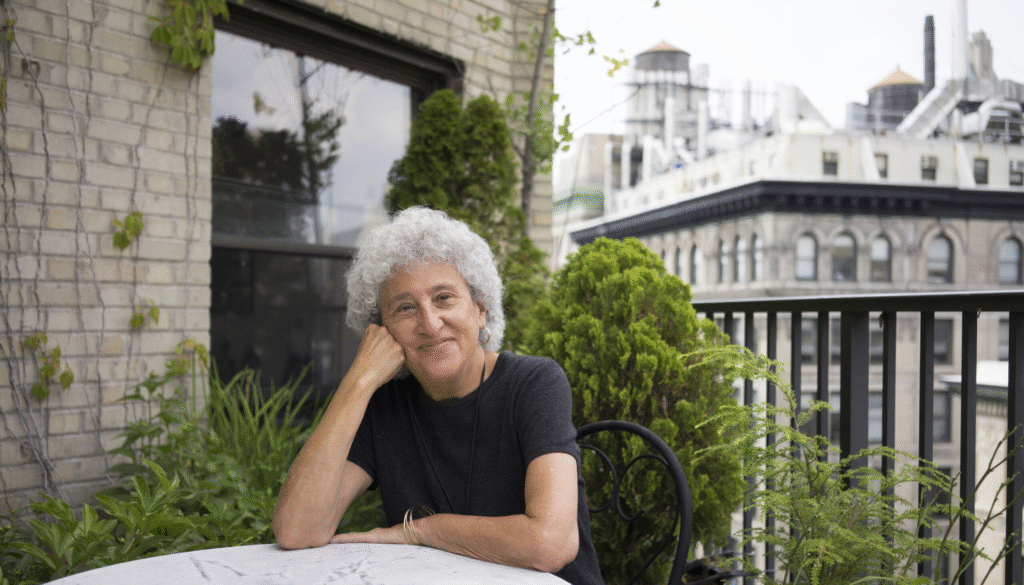
Dan White: You are 89 and deeply engaged in research and writing and public debate, twenty years after most people would have retired. What keeps you so motivated to stay in these conversations?
Marion Nestle: It’s fun. It’s interesting. People are interested in what I have to say, which is flattering. It is really important to be engaged and have things to do. I watch people my age who are retired and not doing anything and it makes me want to run screaming from the room. I am lucky enough to have had a job that let me hang around after I retired, and I get to have contact with students who are really exciting to talk to.
This conversation (with UC Santa Cruz students) was really fun for me. I love hearing what students are interested in and what they care about. I think keeping engaged is really important when you age. I watch unengaged older people and they are not very interesting, because then the only thing they can talk about is their illnesses. Everybody has illnesses. They are not interesting except to you.
Dan White: When did it first occur to you that food is political and that it would be the subject of your life’s research?
Marion Nestle: I was always interested in food. I was first teaching at Brandeis University in the 1970s, teaching cellular molecular biology, which was a slog to teach, and I was given a nutrition class to teach – so that was life-changing.
On the first day I sat down to do research on that class, I was hooked. That hooking came about because I opened up eight different textbooks on nutrition to a list of essential nutrients in the diet. The lists differed in the eight books. They weren’t the same – they were all over the place, and I thought, “well, that is weird.”
Dan White: And you’ve mentioned that you discovered huge problems in some nutritional studies you looked at when you were teaching at Brandeis.
Marion Nestle: Once, I was in the library, and I found this thiamine study that was done in a hospital for women who were mentally ill. I thought that was odd because one of the symptoms of thiamine deficiency is neurological and psychological – how could they be doing studies on thiamine in a mental hospital? And they had these six women on a diet that didn’t have any thiamine in it. The criteria they used to determine whether the deficiency was serious was the women’s level of cooperation with chores around the hospital. I couldn’t believe it!
I also found a study about vitamin C deficiency that was done in a prison. During the study, two of the prisoners escaped, and I thought, “this is not a well-controlled clinical trial.” And I realized any undergrad could read this study and know what was wrong with it, and that this would be a great way to teach undergraduate biology. That was it.
Dan White: When did you first start thinking about the aggressive marketing of ultra-processed food and sugary sodas?
Marion Nestle: When I was teaching at NYU, I went to a National Cancer Institute meeting. The most important anti-smoking advocates in the world were showing slides of cigarette marketing. One of them was a professor at UC San Diego and he did a talk on cigarette marketing to children. He showed slide after slide of Joe Camel (the sunglasses-wearing cartoon camel mascot used by the RJ Reynolds Tobacco Company to market Camel Cigarettes) being displayed everywhere where kids are.
I knew cigarette companies marketed to kids but I never paid attention to it and I walked out of the talk thinking, “we should be doing this for Coca-Cola.” So I started paying attention. The cigarette marketing was so much a part of the landscape that you didn’t notice it. It was just there. There were Joe Camel ads in every store you went into. And I thought, “oh, Coca-Cola.” So I started taking pictures of Coke and Pepsi ads. I started paying attention and put the articles together into my book Food Politics (2002.)
Dan White: You’ve said the American food system needs a revolution. What is most wrong with the system that makes gradual change insufficient?
Marion Nestle: We don’t have publicly funded election campaigns. That to me is the fundamental problem with our society and the one that is in most need of change. If we were able to elect people who were interested in public health rather than corporate health, we would have a very different society. The other thing is shareholder value as the number one priority. We need to have an investment system in which corporations have real societal responsibility while they are extracting all this money from us.
Dan White: How does the current structure of U.S. agriculture put corporate interests above public health?
Marion Nestle: Almost the entire system is set up to feed animals or fuel automobiles. It has nothing to do with food for people. If you look at the Department of Agriculture’s graphs of what happens to corn, half of it goes to animal feed, the other half goes to ethanol. And the same thing is true for soybeans and diesel fuel. The climate would be better, people would be healthier eating less meat, not more meat. It is a system that is set up to make people and the climate unhealthy.
Dan White: You were initially hopeful about the Make America Healthy Again (MAHA) Commission’s first report (released in May 2025) but later you felt the second report rolled back a lot of what was promised. What changed?
Marion Nestle: A lot of things changed. Even on the things that are critically important to the MAHA movement – getting chemicals out of the food supply – it all got dropped and there is plenty of evidence the agricultural industry got to Kennedy. There have been investigative reports that have documented the number of meetings. It is very obvious that that is no longer a priority.
Dan White: The new MAHA dietary guidelines really push meat-centered protein. They are quite aggressive about it.
Marion Nestle: Right.
Dan White: It calls for full-fat dairy. Butter. They even call for beef tallow.
Marion Nestle: Right! (laughing)
Dan White: But Americans are already consuming very large levels of protein and a lot of that comes from meat – so why do you think the new recommendations are being pushed? New MAHA dietary guidelines keep emphasizing meat-based protein. Why do you think this is happening?
Marion Nestle: Because (United States Secretary Of Health And Human Services) Robert F. Kennedy, Jr. eats a carnivore diet. That is the only explanation I can think of. I wrote in my blog that it was the result of meat industry lobbying. Kennedy said he was going to do gold-plated scientific evidence.
So the thing about the protein recommendation that is so bizarre is that it calls for doubling of protein intake from what was .8 grams per kilogram to 1.6. It is one of the few things in dietary guidelines that are specified numerically. Protein is a euphemism for red meat – for beef – in terms of the way people perceive the word protein.
Dan White: How are they justifying this increase?
Marion Nestle: The rationale for it is in the scientific report that came with the guidelines. But the people who wrote the recommendations that were most relevant to meat recommendations were people who had ties to the meat industry – not totally but somewhat – enough. So obviously people were picked to share Kennedy’s ideology.
Kennedy said he consumes a carnivore diet and this has done wonders for his health. Part of the whole business about the MAHA movement is they focus on personal responsibility and personal experience rather than science and in fact Kennedy has said that relying on experts is a form of totalitarianism. So we are seeing ideology in action here.
Now everybody has an ideology but that is why you do committee reports. But these guidelines were not the basis of a committee report. They were the basis of eight or nine individuals who wrote scientific reviews individually, not as a committee, and one person who abstracted those reviews and wrote the scientific basis of the guidelines. We have no idea who did the guidelines though much of what was in them was in the scientific report.
Dan White: In light of these problems, do you feel that collective action or advocacy can be effective in challenging food industry power?
Marion Nestle: It is the only thing that will work – community organizing on a large scale.
Dan White: Is it happening to some degree now?
Marion Nestle: No. Not that I can see.
Dan White: So what would that look like in practice?
Marion Nestle: A mass movement.
Dan White: Why is that not happening right now?
Marion Nestle: Because food is complex and there are lots of issues. There are literally thousands of organizations in the U.S. working on food issues. It has been very, very difficult to form coalitions in part because the goals are fragmented, the leaders are raising money and everyone is competing for the same funding sources, and the goals are not common. It is the fragmented left. It is just really, really difficult to find common goals whereas the MAHA movement was able to pull that off.
Dan White: Yes. They are more organized than the other side.
Marion Nestle: They have done phenomenal community organizing among mothers who have young kids and are worried about all the kids’ health because of all the chemicals in the food supply.
Dan White: So maybe MAHA is a model for a pushback from the food justice movement?
Marion Nestle: Yes. I have just written an article with a colleague in which we talk about what the points of agreement are and the points of disagreement with the food justice movement and MAHA. It will be published in Civil Eats. The commonalities: we all want less ultra-processed food, more real food, chemicals out of the food supply – everybody agrees on that. The points of disagreement are how you go about it. Do you think it is a matter of personal responsibility or does the government have a role? The MAHA movement is all about personal responsibility and personal choice and personal experience.
Dan White: What’s interesting about that is you have made the argument that the placement of products in supermarkets really complicates the idea of personal choice.
Marion Nestle: Oh, of course. Personal choice is never free when it comes to food unless you are growing it yourself.
Dan White: So when someone walks into a supermarket, what are the forces that are already shaping what they are going to see and what they will buy?
Marion Nestle: There are corporate forces. Companies pay supermarkets to place their products where they are most visible – that is, at eye level, at the ends of aisles, in free-standing sections, and at the checkout counter. They are called slotting fees and they represent a major component of supermarket real estate and income.
Dan White: You also talk a lot about consolidation in the grocery industry. Places like Kroger and Albertsons and Walmart and Costco now control such a huge share of grocery sales – how does that concentration influence prices?
Marion Nestle: They can set what they pay to their supply chain so they can keep prices to farmers as low as possible and prices to consumers as high as they can get away with. I don’t know what is going on in grocery stores here. I live in Manhattan. I can’t believe what has happened to food prices.
Dan White: They are very high here, too. I am curious about your views about places like Dollar Tree and Dollar General. They sell mostly ultra-processed food and a tiny bit of produce.
Marion Nestle: They have to have that in order to qualify for SNAP. I think it is possible to go anywhere and eat healthily. Even in a dollar store – it is more difficult but if you know what to do and have enough money, it’s possible.
Dan White: And you point out that places like Whole Foods and Trader Joe’s are in higher income areas.
Marion Nestle: Deliberately. Wegmans – an East Coast chain – is a family-owned business but they now own more than 100 supermarkets. They are very corporate. They built one in my neighborhood in Manhattan. I consider it a personal favor. I mean, it is a fabulous store.
Dan White: You’ve noted that fresh fruits and vegetables have become more expensive relative to ultra-processed food. How does that price gap affect consumer choice?
Marion Nestle: People want to spend as little for food as they can. But a lot of people lack the skills to prepare the food. I got an email just this morning from someone who said that if you want people to eat real food, make sure they have sharp knives, a pot, and a colander.
Dan White: But lots of people haven’t learned how to prepare fresh food.
Marion Nestle: People don’t have the time. Or don’t think they have the time. You have to shop, you have to buy food and prepare food and serve food. You have to do all that stuff. Not everybody can do it. Plus people want to give their kids treats because they can’t buy them sneakers.
Dan White: You’ve highlighted experiences like picking vegetables at summer camp as formative for future consumers. How can schools and communities institutionalize hands-on food education?
Marion Nestle: Well, look at Edible Schoolyard – you’ve got Alice Waters not that far away from here. I haven’t seen her latest cookbooks. Usually she sends these to me. I think Edible Schoolyard is absolutely brilliant and boy does it work. I’ve seen it in action. I have many anecdotes about school food. (THI and Bookshop Santa Cruz co-sponsored a talk by Alice Waters about her new book A School Lunch Revolution in October.)
Dan White: In closing, what do you most want today’s consumers to be mindful of when purchasing food in a supermarket?
Marion Nestle: That if they are trying to eat healthily in a supermarket today they are fighting an entire food system on their own and the food system is bigger than they are and has a lot more. They just have to do the best they can.
The Peggy Downes Baskin Ethics Lecture Series is made possible by the Peggy Downes Baskin Humanities Endowment for Interdisciplinary Ethics, which enables lively dialogue about ethics related challenges in interdisciplinary settings.
Original Link: https://news.ucsc.edu/2026/02/how-corporations-and-politicians-decide-what-you-eat-a-conversation-with-marion-nestle/
Banner Image: Photo of Marion Nestle speaking at the Peggy Downes Baskin Ethics Lecture, Sustainable Food in the Trump Era, at the Cowell Ranch Hay Barn. Photo credit: West Cliff Creative