
Undergraduate Profile: Sophia Coffing
Sophia Coffing is a second-year Psychology and Literature major and The Humanities Institute’s Communications assistant for the 2025-26 Academic Year. In addition, Sophia is also working with Literature Professor Zac Zimmer as a 2025-26 Humanities EXPLORE Fellow, investigating representations of artificial intelligence in contemporary media. We recently spoke to Sophia about her various projects and ongoing journey as a researcher in the Humanities!
Hi Sophia! Thanks for chatting with us. To get us started, could you share a bit about yourself and your academic interests in both Literature and Psychology? Why did you choose these two majors?
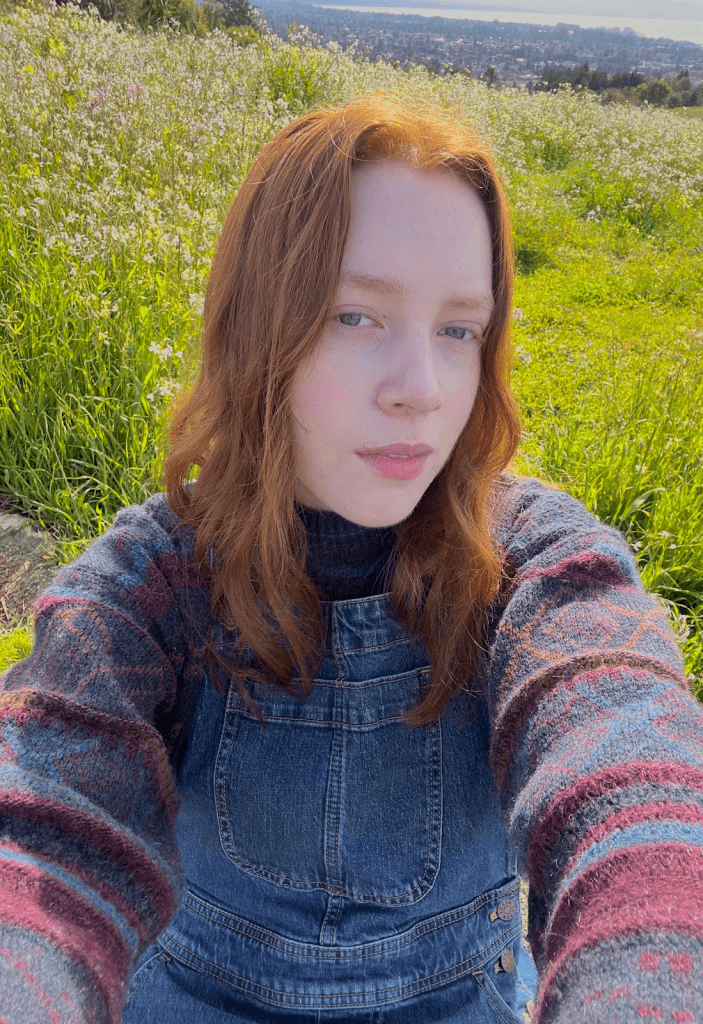
Hello! I’m a second-year student double majoring in Psychology and Literature—two disciplines that I’m deeply interested in. Literature has been a passion of mine for as long as I can remember; I’ve always been fascinated by the ways stories shape our understanding of ourselves and the world around us. Psychology, on the other hand, offers a structured framework for exploring similar questions about human nature and behavior.
It may seem like an unconventional pairing, but I see Psychology as an extension of my literary interests. Both fields seek to illuminate the complexities of human thought and emotion, just through different methodologies. Many of Psychology’s early foundations, like those of Freud and Jung, were heavily influenced by myth, narrative, and literary imagination. At the heart of both disciplines is a shared curiosity: a desire to understand who we are, what we experience, and how we make meaning of it all.
You began your year-long position on The Humanities Institute Communications team this summer and we’ve loved your work! Can you share more about why you were drawn to this position? How has your experience been so far? What was the training like and have you been getting good mentorship from the team?
I was drawn to this position because I wanted to engage more deeply with the humanities community on campus and learn about the work that goes into making humanities research visible and accessible. I was especially interested in seeing how communication can bridge the gap between academic inquiry and public engagement.
Although I started this summer, my experience so far has been wonderful. I’ve learned so much about working in a professional, collaborative environment and how thoughtful communication can highlight the value of humanities work. I’ve been lucky to receive direct mentorship from THI’s Research Programs and Communications Director, Saskia Nauenberg Dunkell, who has been incredibly supportive and insightful.
One of my favorite aspects of the role is getting to hear from student researchers supported by THI. The Institute creates opportunities for humanities students at a time when such support feels both vital and necessary, and it’s inspiring to be part of that effort.
What kind of things are you doing in your new role? Have there been any projects you’ve particularly enjoyed working on?
My role encompasses a variety of communications-related tasks—drafting social media visuals and text, contributing to THI’s weekly newsletter, and designing graphics for upcoming events. Most of my work is structured around ongoing projects and assignments that support THI’s events and programs.
One project I particularly enjoyed was designing a post for Sir Isaac Julien’s Exhibition “All That Changes You. Metamorphosis.” The exhibition featured such stunning visuals—dancing cherubs, models against fresco walls, and ethereal projections—which made it a joy to translate that atmosphere into digital design. It was a perfect example of how art, narrative, and visual communication can come together in one space.
We would love to hear if you’ve seen any connections between the topics you are learning about in your classes and the events and programs THI offers. What would you tell other undergraduate students interested in learning more about THI?
Absolutely. I often notice meaningful connections between what I encounter in my classes and what THI is presenting each week. For instance, a literature lecture on the aesthetics of obsession might coincide with a THI symposium exploring metaphors of consumption; a feminist reading methodology introduced in class could resonate with a guest talk on archival recovery; or a conversation on cognitive psychology might intersect with a panel on AI and creativity.
“[The Humanities Institute] creates opportunities for humanities students at a time when such support feels both vital and necessary, and it’s inspiring to be part of that effort.”
THI has a large range of events within the humanities. It’s hard not to find something that sparks your interest. From author talks to informative workshops, film screenings, and research presentations, THI offers a wide array of humanities events that invite students to engage with ideas both critically and creatively. For students curious about the humanities beyond the classroom, THI is an incredible resource and a welcoming space for exploration.
Over the summer, you also started working with Literature Professor Zac Zimmer as a 2025-26 Humanities EXPLORE Fellow. The Humanities EXPLORE Program is led by the UCSC Humanities Division with strategic support from The Humanities Institute. Can you share a little about the project you’ve been working on? What does the research you’re involved in entail? How has it progressed since the summer? And what will you be working on this Fall?

I was introduced to Professor Zimmer’s research after taking his course Artificial Intelligence and Human Imagination last spring. For my final project—a zine titled “The Degenerative Mirror of AI Technosystems”—I explored the literary motif of doubles and how it resurfaces in our cultural understanding of large language models. That project sparked my interest in how narratives shape the way we think about technology, which led me to apply for the Humanities EXPLORE Fellowship.
Without revealing confidential details, I can say that our research continues to engage with the intersections of literature, technology, and cultural history. I often return to texts we discussed in class, rethinking how they might inform contemporary discussions around AI and scientific imagination. One of the most compelling aspects of this work is its refusal to be narrowly defined. It embraces complexity and resists simplification, which feels true to the spirit of the subjects we are exploring.
How has your EXPLORE fellowship helped you to grow as an academic researcher in the Humanities? Would you recommend the fellowship to other undergraduate students? What advice would you give to students interested in these opportunities?
Even though I’m still early in the process, the fellowship has already helped me learn the expectations of research. It’s given me a clearer sense of what academic research in the humanities looks like—its self-disciplined structures, challenges, and the creative thinking it requires. It’s also taught me that research isn’t always linear or neatly structured; it often unfolds in surprising, generative ways.
I would absolutely recommend the fellowship to other students. You don’t need to have everything figured out before you apply, just curiosity and a willingness to engage deeply with ideas. You might discover that research is something you truly enjoy and want to pursue further, or that it helps you develop new skills applicable to other paths. Either way, it’s an incredibly valuable experience. I’m looking forward to continuing to develop as a researcher. To keep asking difficult questions, refining my methods, and learning from the mentorship and conversations that this fellowship makes possible.
You have a busy academic year ahead of you! To wrap up, what is something non-academic you’re looking forward to in the upcoming year?
As a film enthusiast, I’m really looking forward to the quarterly Film Festival hosted by On the Spot (OTS), Student Cable Television (SCTV), and the Film Production Coalition (FPC). I was part of the student-run EyeCandy Film Journal during my first year, which gave me the perfect excuse to write about my favorite movies and connect with film majors on campus. Their creativity and dedication always amaze me—it’s inspiring to see the results of their hard work. I’d definitely recommend that anyone interested in film check it out!
Banner image: The Humanities 1 Building at UCSC. All other images were taken by Sophia Coffing.