
Faculty Profile: Anjali Arondekar
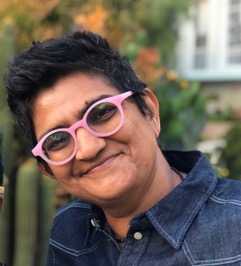
Anjali Arondekar is the Peggy and Jack Baskin Foundation Presidential Chair of Feminist Studies at UC Santa Cruz and Founding Director of the Center for South Asian Studies from 2020-2024. This year, Professor Arondekar is a 2025-26 Faculty Fellow at The Humanities Institute, working on her project, “Oceanic Sex: Archives of Caste and Indenture.” We recently talked with Professor Arondekar about her research and experience conducting preliminary fieldwork in Mauritius.
Hi Professor Arondekar! Thank you for agreeing to speak with us about your 2025-26 THI Faculty Research Fellowship. To begin, could you please tell us a little bit about yourself and your research interests?
My work engages the politics and poetics of sexuality, caste and historiography, with a strong focus on comparative empires within South Asian and Indian Ocean studies. I am primarily interested in three concepts that have increasingly become the focii of methodological debates within historical and/or literary studies: archives (what constitutes historical evidence), exemplarity (how do we read evidence) and geopolitics (where do we read from). Such methodological concerns bring genealogies of area studies to bear on Anglo-American histories of literature and culture and ask how such an attention to “area” calibrates questions of race, gender and sexuality. Broadly speaking, I read and write within established disciplines (history, literature, law) and field formations (area studies, queer/sexuality studies), mobilizing South Asia through its multilingual and divergent colonial and national formations.
Your work often moves across different archives and geographies. What guides your approach to comparison in this project?
My interest in comparative historiography – how history is written, interpreted, and researched – has now engaged me for over two decades, and I have turned repeatedly to the evidentiary regimes through which we forge histories, the hermeneutical demands placed on minoritized histories, and the scripted mandates of evidence, geopolitics and verification.
My first book (For the Record: On Sexuality and the Colonial Archive in India) engaged histories of sexuality in nineteenth-century British India, while my second monograph, Abundance: Sexuality and Historiography traversed archives of caste and sexuality within the territories of Portuguese India. This current project Oceanic Sex: Archives of Caste and Indenture, couples the archival forms of indenture with the oceanic voyages of caste and sexuality. Caste remains the embodied archive through which traces of gender and sexuality within the contracted/imaginaries of indenture emerge.
You’ve written extensively about the archive across your body of work. How does your ongoing interest in archival form inform the approach you take in Oceanic Sex and the kinds of histories you’re tracing?
In my work, I have repeatedly refused the ‘show and tell/prove that we exist’ historical method that requires archival erasure before it can imagine presence, to think more about what it means not to be data/fodder for a knowledge supply chain that sees minoritized histories only through archives of loss, dispossession, and paucity. Instead, in this project (as I have done in my earlier work as well) I want to summon histories of caste and sexuality that clog up the data stream, through a radical caste hermeneutics, of Dalit/Bahujan imaginaries as andolan (protest) visions that would cull the creative fury of the bahu (expanse) of lower-caste subjects. Archives of caste and sexuality remain the interlude, the kala/the aesthetics within the historical records of indenture, the alankar/the composition that weans us away from our imaginaries of data- gathering and systems of verification. To forge such an archival grammar of dissent, we must refuse metonymic deployment, do more than witness, become – and indeed inhabit – a different order of historical presence. We must move from keeping the story alive to keeping the subject alive.
You spent the past two summers conducting preliminary research in the National Archives at Mauritius. What did this preliminary research reveal? Was there a specific textual encounter or a specific moment of surprise, shock, awe, or understanding that stands out to you?
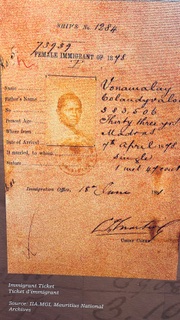
For indenture to be distinct from slavery, we must have records of how indenture fails its own promise, because failure, after all, materializes the fantasy of freedom. For the colonial archive of indenture and its bureaucratic afterlives to work, petitions, cases, dispatches, reports are composed, revised and circulated –all centering not the successes of indenture but rather its scandals, leakages, betrayals and ruptures. At the heart of such archival gathering is the growing and ordinary preponderance of archival unreliability – contaminating the very infrastructure of colonial technologies such as contracts, identity papers, gender roles and more. From the moment of arrival to settlement, and even departure, the archives of indenture participate in an assemblage of fictions and histories around what numbers anchor and secure. How one is inscribed as an archival form (in this case, as a number) is always under question, and indeed, foundational to the very story of indenture.
In some defiance (though not in opposition) of the wisdom that enshrines colonial archives of indenture as the nadir of minoritized histories, as records of violence and erasure, my archival research in Mauritius returns to mid-to late 19th century colonial petitions, even as they expose their frayed edges. Rather than inhabit a language of scandal, secrecy and/or exposure, petitions with reference to gender and sexuality (between 1865-1920) openly append themselves to records of indenture, an aleatory bricolage of diverse voices and ersatz genres of evidence whose cumulative force invites closer attention.
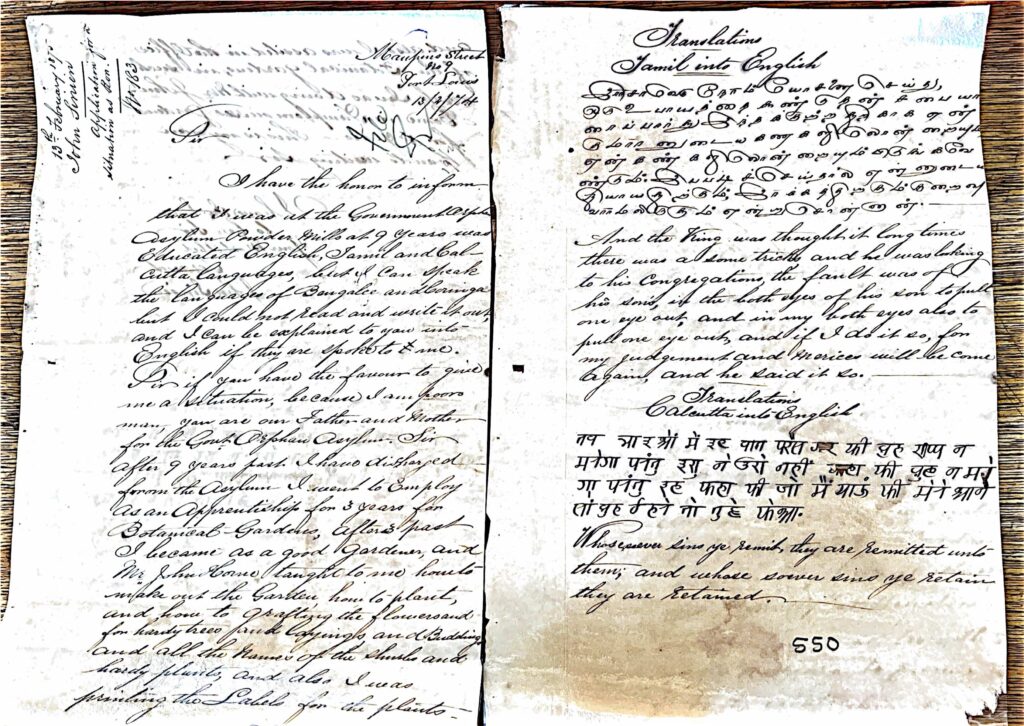
The petitions are often multi-lingual, written in English, French, and occasionally Bhojpuri, Hindi and Tamil, and multi-generic, containing letters, first person witness accounts, police records, forensic evaluations and more. Performing more the function of an archival punctum, the petitions are a disruptive genre whose contents spill over the borders of evidence, supplementing its curated function. Of stake here is the role sexualized labor (beyond the stabilizing sites of reproductive labor) played in the infrastructure of archiving indenture. From crimes of passion, abscondence and infidelity, to seemingly mundane matters of marriage certificates, identification cards and inheritance, the petitions are a cabinet of curiosities, refurbishing the scaffold of the official archive. Within these records, gender, sexuality and indenture repeatedly meld, to produce the evidence of persons and subjects.
What do you hope your research project will make visible that earlier histories of indenture in the region have overlooked?
Rather than think of the archives of caste and sexuality as exemplary or resistive, I want to make the case for their constitutive contradiction: they are indispensable to the evidentiary regimes of indenture as they are beyond the grasp of recuperative analysis. These archives require us to write, to read, and research histories that unravel at the very moment of their facticity. There is so much more to say in this unravelling history of oceanic sex; indeed, it is a Scheherazadean tale, borne through the violence of narrative capture, even as the possibility of freedom remains. The story of these oceanic bodies speaks also to the myriad archival forms of caste and sexuality –each iteration a lesson in the oceanic history of indenture. Yet we narrate to thrive, not just to survive. In the words of the Mauritian writer, Ananda Devi: Ton archive mime un secret,/ depuis bien longtemps révélé (Your archive/presence apes a secret that has long been told). In the archive, the subject is alive. Let us imagine those histories together.
Join Professor Arondekar this April 3-4 for “Oceans of Dissent: A Feminist Commons,” a conference presented by the Chair in Feminist Studies and co-sponsored by the UCSC Humanities Divison, the Center for South Asian Studies, and the Center for the Middle East and North Africa.
Banner image: Map of Mauritius (1880) and Admiralty Chart of Grand Port (1843) courtesy of Wikimedia Commons.

