
Events

- This event has passed.
Arts and Ecology Festival
April 22, 2026 @ 1:15 pm - 10:00 pm | Digital Arts Research Center
The first Arts & Ecology Festival at UC Santa Cruz will bring together talks and panels featuring artists, scientists, and researchers. The April 22 program includes film screenings, live music, artworks, a clothing swap, a poetry slam, a solar powered mobile projection system, and groups like the Norris Center of Natural History, The Fábrica community textile Arts & Salvage Workshop in Santa Cruz, and a mobile podcast booth from UC Davis for participants to respond to climate-focused prompts, capturing creative perspectives on climate change.
This program is part of OpenLab Collaborative Research Center, led by Jennifer Parker, with support from the Art Department and the University of California Climate Action Arts Network (UC CAAN). UC CAAN is a new system wide initiative to support creative research, scholars, students, and community partners to address the climate crisis through the transformative power of the arts. The network is supported by the University of California Office of the President through its Multicampus Research Programs and Initiatives (MRPI) grant program.
Learn more at the Arts & Ecology Festival website.
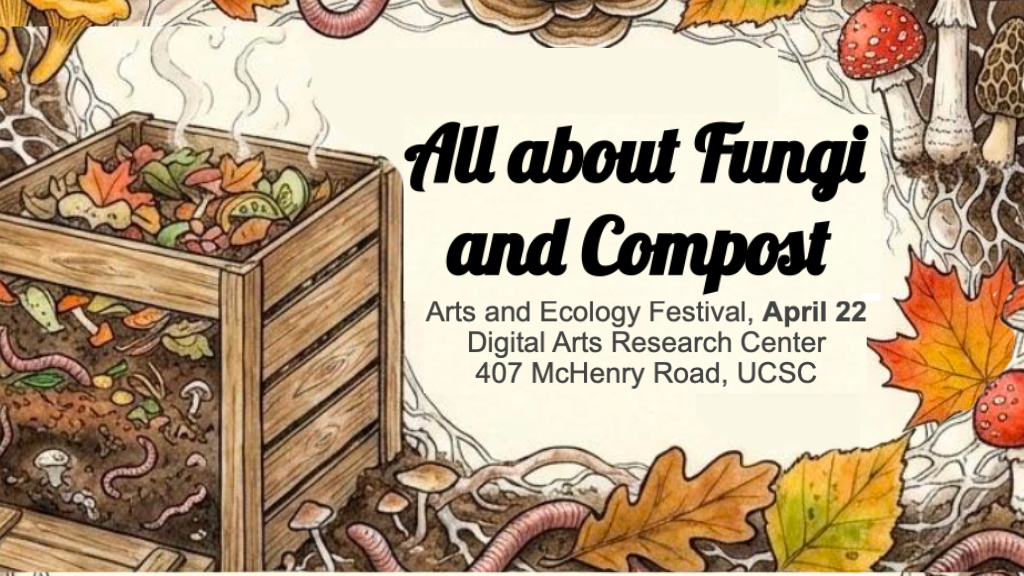
The Humanities Institute’s Deep Read program is co-sponsoring a Compost and Fungi: Interactive Talk at 5 pm on Megafires, Floods and Fungi.
With the rise of catastrophic megafires and flooding, we look to fungi and other microbes as nature’s mediators between fire and water. They sink carbon, retain water, prevent erosion, digest toxins, and establish ecological balance in both pre and post fire ecosystems. As fires enter the human-made environment more regularly, there is a growing concern about post-fire toxic ash, and the consequences of ash-runoff entering the surrounding waterways. Wildfire also provides a unique opportunity to revitalize ecosystems, restore water and maximize nutrient cycling. There is a growing grassroots network with hubs in Colorado, California and Hawaii that seeks to generate fire resilience by allying with fungi and other microbes. CoRenewal’s FENiXS program and the Biome Logs Project are evaluating the efficacy of fungal inoculation, with the aim of producing widely applicable tools and methodologies to facilitate ecological regeneration and recovery in the aftermath of disaster and environmental injustice, while honoring and taking inspiration from indigenous relationships with fire and fungi. In this participatory workshop, we will discuss how to organize and integrate inoculants into land tending practices, as well as how to contribute to community science that supports these efforts.