
Graduate Profile: Joshua Lieberstein
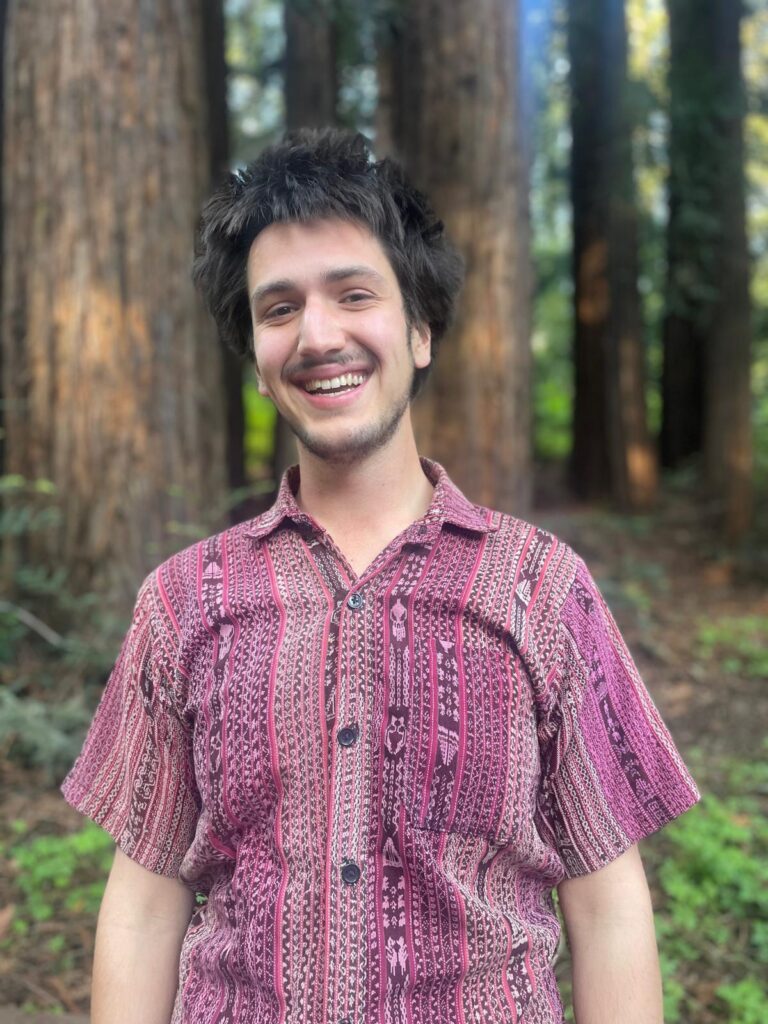
Joshua Lieberstein is a first-year MA student in Linguistics and was a 2024-25 THI Undergraduate Research Fellow. His fellowship project examined verbless clauses – grammatical structures that provide a complete thought but which lack verbs – in the Mayan K’iche’ dialect. Joshua has continued working with Mayan K’iche’ as an MA student, focusing in particular on the verbal syntax for his Master’s Thesis. For both projects, Joshua has traveled several times to Chichicastenango, Guatemala to learn K’iche’, conduct fieldwork, and build relationships with the local community and native K’iche’ speakers. We recently caught up with Joshua to learn more about his research as a THI Fellow, his travels, and his experience in the Linguistics Department.
Hi Joshua! Thanks for chatting with us. To start off, could you please tell us a little bit about yourself and your research interests?
Thanks so much for the opportunity to share my story! My name is Joshua Lieberstein and I am a first year Master’s student in the Linguistics department here at Santa Cruz. I started with my BA in Linguistics at Santa Cruz and then took the 4+1 track to do my MA here as well. I didn’t know I was going to end up being a linguist, but the department at UCSC is one of the best in the nation and they got me hooked. I kept coming back to the core question underlying Linguistics: How are human languages connected and what are the underlying commonalities that they all share? To make a contribution of my own to this question, in the fall of 2024 I started doing fieldwork on K’iche’, a Guatemalan Mayan language spoken by around a million people. I specifically focus on the Chichicastenango dialect which is a regional variety with only 70,000 speakers and a major part of my research is working with native speakers in Chichicastenango to document the uniqueness of their variety.
My primary collaborator, who has taught me much about his language in our almost two years of working together, is Juan Genardo Saquic Jorge. I am immensely grateful to him for his patience with me as we work through all aspects of his language and for his generosity in sharing his culture with me. Working with Juan Genardo along with other speakers involves the recording of folk stories and personal narratives in addition to more targeted investigations of the grammar through elicitation sessions. For a typical elicitation session, I create sentences in K’iche’ and ask my collaborator if these sentences are well-formed, given a context. I also provide sentences in Spanish and ask for translations to K’iche’, if there are words I haven’t yet learned. Each session is guided by a research question, and the sentences created are all in service of making progress both on the description and theoretical analysis of the language.
As a fieldworker, my theoretical research interests are quite broad but they are contained within the generative linguistics tradition I was trained in. Since I spend almost all my time thinking about one language, K’iche’, I have to consider all that the language has to offer. I have written about the phonology (how sounds pattern together at an abstract level), the phonetics (how sounds function at an acoustic level), the semantics (the meaning that words/sentences have) and the syntax (how sentences are structured) of Chichicastenango K’iche’. But if I had to pick just one subfield of Linguistics to do for the rest of my days, it would be syntax (Jorge Hankamer’s fault, my mentor and friend).
You were a 2024-25 THI Undergraduate Research Fellow. Can you talk about the project you worked on for your fellowship?
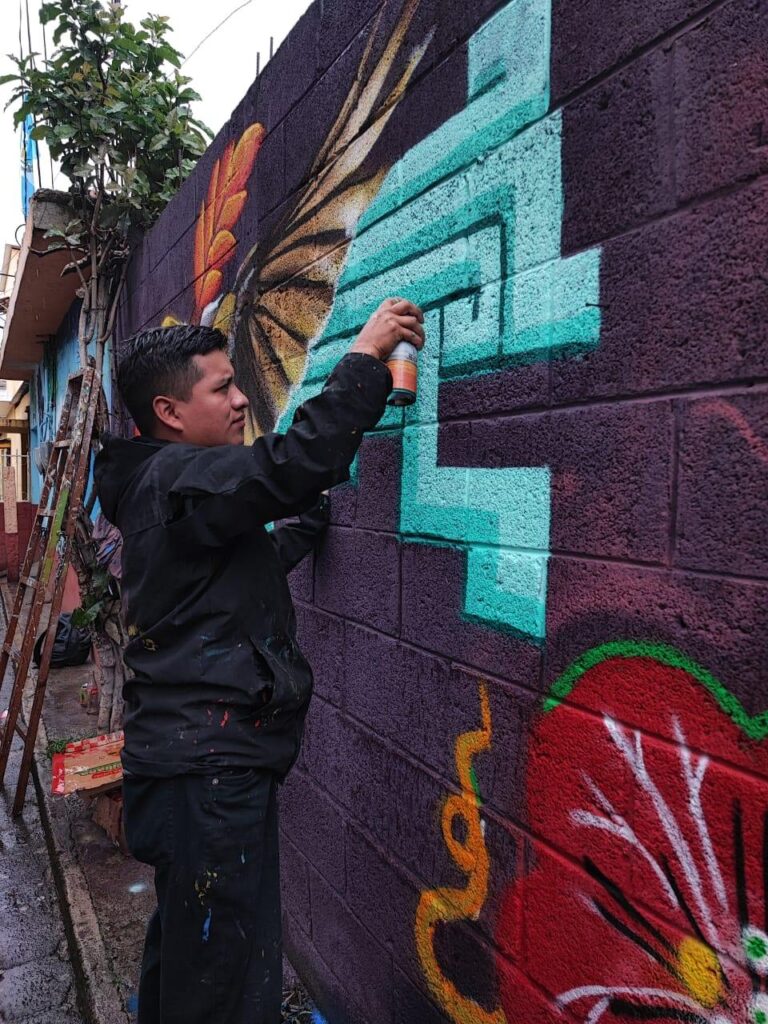
I was honored to receive the THI Undergraduate Research Fellowship and it gave me more resources to work with the speakers of Chichicastenango K’iche’. When I first started documenting the language, I was struck by the fact that many sentences had no verb at all. Coming from a language like English, where almost every sentence has a verb, I became fascinated. I titled the project: Verbless Clauses in K’iche’ (Mayan): A (Non)-Copular Investigation and discovered that the big difference between K’iche’ and English is that K’iche’ lacks the ‘copula’ to be. In English, where one would say ‘I am a teacher’ or ‘I want to be a teacher’, K’iche’ expresses the same sentiment without the verb to be. For example, in ajtij ‘I (am a) teacher’. Similarly for emotions, instead of saying ‘I am happy’ one can say kikt’mal chwe ‘happiness (is) upon me’. In K’iche’, there is just no word for to be when talking about the properties of an individual.
This led me down a rabbit hole of investigating verbless clauses in K’iche’ and I found some pretty consistent patterns. Although sentences like ‘I am a teacher’ lack a copula in K’iche’, sentences that seem to be almost the same e.g. ‘The teacher is me’ do have an additional word, that sure seems to be doing the job of English to be: arë’. However, sentences with this word, arë’, all involve equating two individuals, similar to: ‘Clark Kent is Superman’. And even in these scenarios arë’ ≈ ‘to be’ is optional!
From this, I found out that K’iche’ is not alone in having this pattern. Previous research showed that many languages across the world lack a word for to be in sentences like ‘I am a teacher’ and the correlation is that these languages lack a system of tense (past, present, future) and use other means to express temporal relations in the grammar. I presented these findings as a poster at last year’s Celebrating the Humanities event and received some really great feedback from my peers and professors.
In your application, you mentioned that you had spent some time in Guatemala prior to your fellowship. Can you share more about that experience and what drew your interest to Mayan K’iche’?
I always love answering this question. I went to Guatemala for the first time in 2024 on a whim to learn Spanish, and had no idea that I was going to end up working on K’iche’. It was a pre-requisite of my degree that I learn a foreign language and I was already building up my fluency in Spanish but I wanted to have the full immersion experience. About two months before I left, my grandfather, who is a professor, suggested I make my trip ‘more academic’ (as if learning Spanish for two months isn’t academic). I was already quite deep into the linguistics track and I heeded his suggestion. I looked into what the local languages of Guatemala were and I vividly remember the google search that led me to discovering K’iche’, followed by the further discovery that the city I would be learning Spanish in was surrounded by towns that all had their own dialects. I was beyond excited… I was ecstatic.
My first few weeks in Guatemala were spent learning Spanish and K’iche’ simultaneously; Spanish in the mornings at a school and K’iche’ in the afternoons through an online resource created by UT Austin. After I finished my Spanish program, I did a week intensive in K’iche’ and then had the chance to travel Guatemala for a month. Through a stroke of fate after being pickpocketed on a ‘chicken bus’, I ended up in Chichicastenango with no phone and the onsets of Dengue Fever.
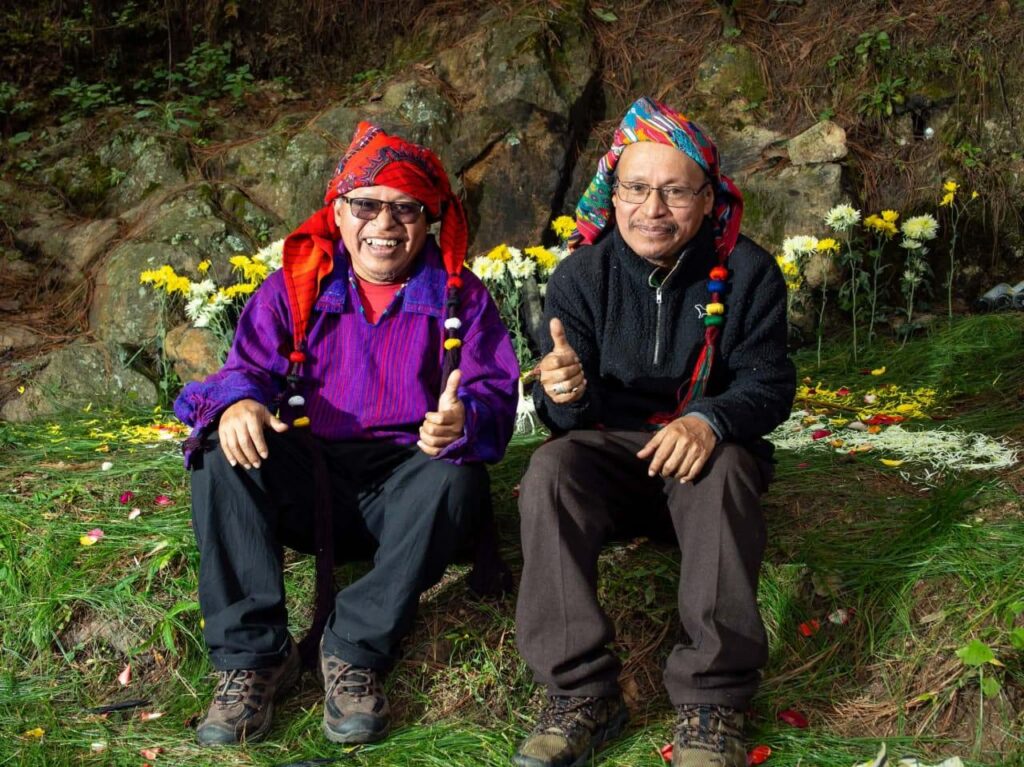
This was a blessing in disguise because I ended up staying with two local community leaders: Juan and Miguel León Cortez at their Galeria Pop Wuj. Juan and Miguel are ajq’ijab’— the traditional daykeepers of the Mayan calendar, spiritual guides and talented artists. They cared for me, taught me much about their culture and helped me build relationships with local native speakers for the two weeks I was there. The following summer in 2025, after my fellowship, I returned to Guatemala to take an intensive K’iche’ language course and stay with Juan and Miguel once more to work with the same speakers I had met a year prior and continue growing my network of connections.
As for my interest in K’iche’, it truly was accidental but a big part of what keeps me fascinated in K’iche’, and Mayan more generally, is the culture and history. There is so much to learn and know, and I feel that having some insight into the language helps me understand just a little more the immenseness of their history before the Spaniards arrived and how they are working to maintain that culture even today.
What was it like to conduct independent research as a THI Undergraduate Research Fellow and present your work at the end of the year? How did that experience shape your decision to continue in Linguistics as an MA student?
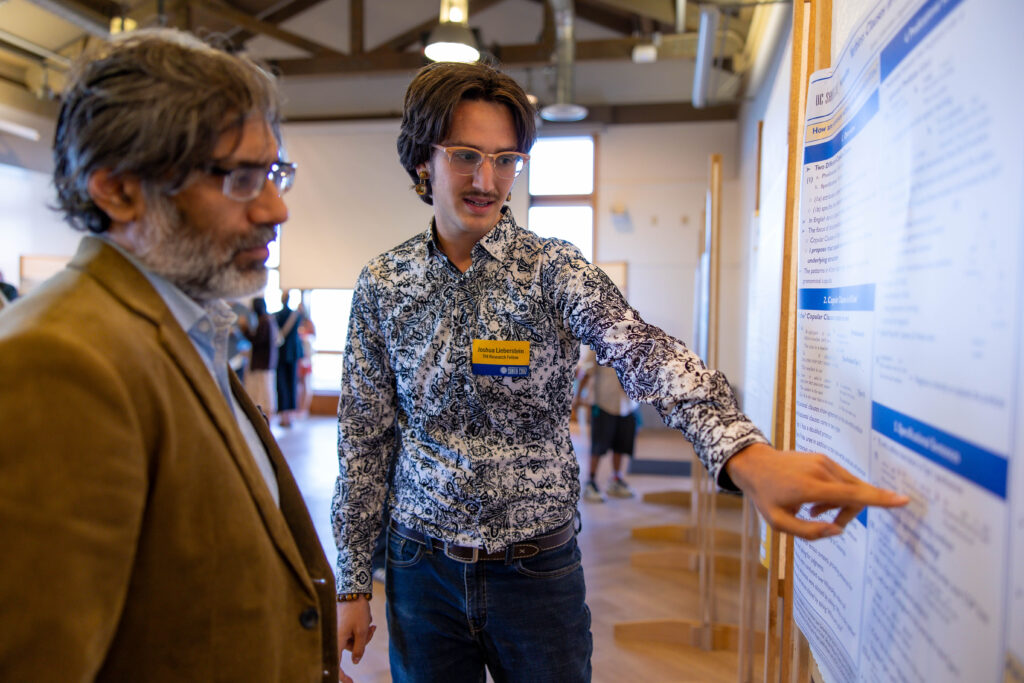
The THI fellowship I received enabled me in a big way to pursue my burgeoning research program on Chichicastenango K’iche’. It was empowering to have the opportunity to conduct my own independent research and put into practice the tools I had learned in my undergraduate coursework up until that point. I was quite pleased with the end-result of my project and presenting it at the THI Award Ceremony was a great capstone to the project. I also had the opportunity to present my work at a department-internal event LURC: the Linguistics Undergraduate Research Colloquium and sharing my results there with my colleagues was really wonderful.
The year that I received the fellowship, I was already on the 4+1 pathway for an MA, but the funding from THI and the vote of confidence in my research really solidified for me that I was on the right track. It was during the development of this project that I began building a working relationship with Dr. Roumyana Pancheva. Roumi guided me throughout the duration of the fellowship and really helped improve the quality of my work. The structure of the THI fellowship was instrumental in forming the foundations of the mentorship I receive. Roumi is now one of the co-advisors for my MA thesis and continues to be a pillar of support for my ongoing research.
We’d love to hear about your MA thesis. What are you currently working on, and does it build on your earlier research?
For my MA thesis, I’m continuing to work on the Chichicastenango K’iche’ dialect but in a turn of events, I am now focusing on the verbal syntax instead of the verbless clauses that fascinated me during my THI fellowship. When I went to Guatemala this past summer, I had a plan to confirm all the data from my THI project, which I did, but in the course of my three week stay in Chichicastenango, I discovered another phenomenon involving verbs and responses to yes/no questions that began to occupy all my attention. Take English as a starting point, if someone asks Did John go to the store? there are a few possible responses:He did. Yes. Or Yes, he did. This is roughly the pattern for all positive English yes/no questions. However, in K’iche’, the response to the question Did John go to the store? is roughly went; one repeats the verb to the exclusion of all other material. This pattern of responses is present in about half of the world’s languages, and they are known as Echo Answers, since the verb is ‘echoed’ in the response.
My thesis investigates how these Echo Answers come to be in K’iche’ specifically and also makes predictions cross-linguistically for when and where a language will have Echo Answers. For English, the response to the question is typically thought to involve ellipsis, a process where material that would be repeated from a previous utterance, may go unpronounced. For example, the response ‘He did’ is assumed to contain the unpronounced material go to the store and so the full sentence would be He did <go to the store>, where the struck out portion is not pronounced. The word that is stranded following the ellipsis tends to be do in English, but in K’iche’, it is the verb and I analyze the response as went <John to the store>, where the only word remaining un-deleted is the verb.
From this, a major part of my thesis looks at the system of polarity in K’iche’ (i.e. positive/negative sentences) to try and understand why K’iche’ and English would differ in their manner of responding to questions. My current proposal is that the difference has to do with how polarity is expressed in the languages. If negative polarity is added to a typical English sentence like John went to the store, another element ‘do’ has to be added to ‘support’ the negative particle: John did not go to the store. There are a few other words in English that can ‘support’ the negative particle (e.g. be, have), but in the general case it is do. On the other hand, K’iche’ allows for negation to go directly onto the verb, no other element is necessary ≈ John not went to the store. The possibility of the verb itself to host polarity is integral to the syntax of the language, and, I propose, is the reason why K’iche’ and English have this fundamental difference in responses to questions. I also extend this investigation to other Mayan languages and find that some of them pattern more like English in that another element besides the verb is the response to polar questions, which I analyze as having to do with differences in the expression of polarity across Mayan.
Reflecting on your academic journey at UC Santa Cruz, what have been some of the most meaningful experiences for you? And what advice would you offer to students interested in pursuing humanities research?
The most impactful experience has to be my Intro to Linguistics course in my second quarter as a freshman. Jorge Hankamer was the professor and I didn’t know at the time, but he was the founder of the Linguistics department at UCSC. I would chat with him on walks back to Stevenson from the classroom and at the end of the quarter he invited me to take his Syntax 1 class, even though I hadn’t met all the requirements necessary. After taking Syntax 1, he invited me to an even smaller course, Syntax 4, and it was there that I really began my foray into linguistics. Jorge’s belief in me and his pushing me out of my comfort zone really inspired me to go further into linguistics. Eventually, I decided to drop the major I had started with, Cognitive Science, in favor of the linguistics track and Jorge’s mentorship was one of the key reasons for the switch.
All of my other meaningful experiences are time spent with my professors and their impact on me at every stage of my time here at UCSC. In my second and third years, Matt Wagers was a wonderful mentor who guided me through creating and running my own experiment, writing it up as an abstract, presenting it at a conference and eventually submitting it for publication to a small journal. I already mentioned Roumyana Pancheva, but she has been integral in my success at UCSC and as an academic. She allowed me to audit her grad-level Syntax A course in my third year, which really inspired me and confirmed that grad school was right for me. We began meeting semi-regularly the following Fall and her consistent support and feedback kept pushing me to greater heights, and still do so today. My other co-advisor, Maziar Toosarvandani, has been a key player in my development as a fieldworker in the past year. I went in naive, fully self-taught, and his support has really improved my methodology.
I have also benefited greatly from speaking with Emeritus Faculty at UCSC. Jim McCloskey was a huge inspiration for me to become a syntactician, and the few meetings I had with him were so compelling and engaging. His love for syntax is contagious and it was a conversation with Jim that inspired the topic for my MA thesis. Judith Aissen, one of the leading Mayanists in the field, took me under her wing once I started working on K’iche’ and she has been extremely generous in sharing her knowledge with me and giving me feedback on my own projects. Both Jim and Judith are legends in the field of linguistics, and it’s really something that I was able to meet with them throughout my time at UCSC.
Lastly, a senior grad student in the program left a huge impact on me, Dan Brodkin. He was in his final year of the doctoral program when I was in my final year of undergrad, but he saw something in me and mentored me throughout his last year. We still stay in touch to this day and having his support is really fantastic.
My advice to any students interested in pursuing research, is to make connections with those senior to you. Whether that be faculty or graduate students, having good mentors is integral to becoming a good researcher. Go to office hours, stay and chat with your professor or TA after class ends, and don’t be afraid to send e-mails! A lot of the connections I made would never exist if I hadn’t sent that first e-mail. Once the connection is made, the rest will fall into place, and hopefully the mentors will guide you to where you need to be and see what you do best.
Banner image: Tikal, an ancient Mayan citadel in the rainforests of Northern Guatemala. Photograph taken by Joshua.