
Week 3: Strange Analogies – Zombie Fungi and Magic Mushrooms, Mycorrhizal Fungi and Networks
Welcome to the third week of reading Entangled Life together. In this installment, we’ll look at the analogies that Sheldrake uses to explore the nature of two key entanglements that feature prominently in Chapters 4-6 (“Mycelial Minds,” “Before Roots,” and “Wood Wide Webs”): 1) the effects mind-altering fungi have on human behavior and consciousness and 2) the resource-sharing relationship between fungi and plants in forests and plant communities. In the first case, Sheldrake creates an analogy of his own, juxtaposing “zombie fungi” that modify carpenter ant behavior with “magic mushrooms” that modify ours to examine whether fungi can be understood to “occupy” our minds and senses. Are psilocybin mushrooms speaking through us, staging a human takeover when we are under their sway? What might we see (and perhaps not see) by setting up a seemingly strange analogy between zombie fungi and psilocybin mushrooms, between carpenter ants and us? What should we make of the use of the word “zombie” to describe this mind-altering fungi and process, given the colonial origins of the term? In the second case, Sheldrake takes up the now common analogy of mycorrhizal fungi to networks, what’s called the “wood wide web,” to question this familiar comparison. In doing so, he explores whether the network analogy is helping or hindering our understanding of what it is supposed to illuminate – fungi and their relationships to plants and plant communities. What might we miss when we apply a well-worn network model to fungal-plant relationships? Maybe the common, in this case, should be made strange? With the help of Professors Ben Breen (History), Hannah Cole (Literature), and Greg Gilbert (Environmental Studies), we’ll explore these questions and more. Let’s get started …

Mycelial Mind Manipulation: Zombie Fungi, Psilocybin, Carpenter Ants, and Us
While fungal and non-fungal mind-manipulation of animal hosts is not exceptional, the example we know most about is a particular “zombie fungus,” Ophiocordyceps unilateralis. It has captured scientific as well as cultural interest, taking center stage in scientific research and appearing in a fictionalized guise in video games and television shows like The Last of Us and in the book and film The Girl with All the Gifts. We’ll focus on science for now, but it’s interesting to keep in mind that Sheldrake follows in the wake of a cultural move to incorporate zombie fungi into the realm of human life, even if he does so in a decidedly non-apocalyptic way that follows rather than takes free rein with scientific fact and understanding.
What happens with Ophiocordyceps and its infected carpenter ant hosts reads like an expert bodily “hijacking”: the fungus infects an ant in a climate perfect for fungal fruiting, lures it away from its colony and nest, compels it to march to a height it instinctively fears, turns it toward the sun at noon, and obliges it to to bite onto a major vein of a leaf (98% of the time, and all of this in synchrony if many ants are infected). In the process, the fungi’s mycelia grow inside and outside of the ant’s body, securing it to the leaf where the fungi will consume its body and sprout a fungal stalk out of its head, which will release spores on passing ants below and continue the body-snatching cycle (96). The infected ant, Sheldrake will later say, “becomes fungus” (107). How these fungi do this, as Sheldrake notes, has “long puzzled researchers.” In a 2017 study, one expert David Hughes discovered that the fungus takes over as much as 40% of the ant’s body, becoming a kind of “prosthetic organ” of the ant. Surprisingly, it is nowhere to be found in the ant’s brain. The fungi’s effect, Sheldrake explains, “appears to be pharmacological”; the suspicion is that the fungi can “puppeteer” the ant’s body by releasing chemicals that act on their bodies and nervous systems. While scientists don’t know what these chemicals are exactly, they do know that Ophiocordyceps is related to ergot fungi, the compounds isolated to produce LSD, a classified psychedelic and entheogen like psilocybin (96-7). This is the thread that leads us from zombie fungi and carpenter ants to magic mushrooms and us.
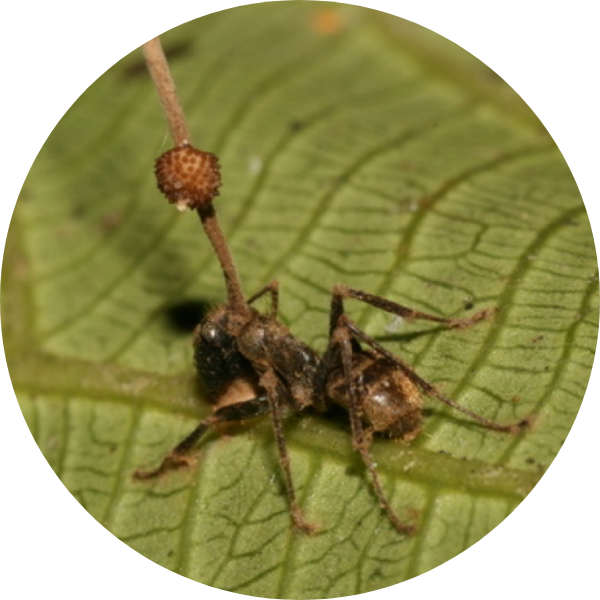
Upon making this move to psilocybin and us, Sheldrake points to many resonances with the zombie fungi paradigm – one being a shared evocation of “hybrid beings and interspecies transformations” (104). He sees echoes of the hybrid form that Ophiocordyceps becomes when infecting their hosts (what Hughes calls a “fungus in ant’s clothing”) in accounts of psychedelic experiences that can involve visions of hybrid beings. This is an account of hybridity that Sheldrake also links to traditional myths and fairy tales as well as to traditional cultures that believe “composite creatures exist,” such as some Indigenous Amazonian societies (106). Now, while Sheldrake notes that this connection with hybrid forms could sound far-fetched, or well outside of conventional scientific thinking and “the limits of biological possibility,” he reminds us that our understanding of symbiosis points to the fact that “life is full of hybrid lifeforms, like lichens.” He describes how “composite beings” are the case – plants, fungi, animals, and humans are all, in a sense, hybrid beings. As he explains, “we all inhabit bodies that we share with a multitude of microbes without which we could not grow, behave, and reproduce as we do” … and “it’s possible that many of these beneficial microbes share some of the manipulative abilities of parasites like Ophiocordyceps” (105). Here, the strange analogy evokes a reality that should be more familiar and commonplace – that most individual organisms are always already hybrid.
While the zombie fungus/psychedelic mushroom analogy serves as a dramatic, even sensational, reminder of a fundamental biological reality, it is also one Sheldrake uses to establish zombie fungi as a kind of evolutionary “harm” to psilocybin’s evolutionary “cure”: “Ophiocordyceps and other insect-manipulating fungi have evolved a remarkable ability to cause harm to the animals they influence. Psilocybin mushrooms, as a growing number of studies report, have evolved an astonishing ability to cure a wide range of human problems” (107). Sheldrake cites research showing that psilocybin mushrooms can alleviate symptoms of anxiety and depression as well as improve mood and outlook. Recent studies have also found that psilocybin can lead to long-term reductions in feelings of alienation and hopelessness and elevations in feelings of connection and “joy, bliss, and love,” even after very small, single doses (107-8). Modern scientific research, Sheldrake says, is in many ways “simply catching up” to something that is commonly known in traditional cultures that incorporate psychoactive substances as medicinal and ritualistic agents. And while research has shown that psilocybin and other psychedelics act “on symptoms of mental illness via the mind” by, surprisingly, reducing activity in the brain rather than stimulating it, there is still much uncertainty about how psilocybin and other psychedelics actually work on us and elicit these reported beneficial effects.
For historians of science like Ben Breen, this uncertainty is what makes psychedelic science so interesting to research and study: “I find psychedelic science fascinating because it’s the combination of a universal human impulse (healing and the desire to alter states of consciousness) with something quite new – institutionalized science and medicine. So, on the one hand, it pulls in all of these ideas and topics from cultural anthropology, history, and archaeology, but, on the other, it’s a cutting-edge field that contemporary clinicians and researchers are just beginning to explore. I find that tension between ancient and modern, familiar and new really interesting. And I also just think psychedelics are inherently interesting for the reason Sheldrake identifies: the continuing mystery of why and how they work on human brains.”
Throughout Entangled Life, Sheldrake probes this mystery that Breen speaks of by adopting a fungal point of view, which is another way he deploys the zombie fungus/psychedelic mushroom analogy. As with zombie fungi and carpenter ants, Sheldrake leads us to look at what’s in this for the psychedelic fungi, not just us (remember, fungi are supposed to be our “teachers”). Still, he concludes that the analogy can only go so far. Psilocybin-producing fungi are not “wearing our bodies” and controlling our minds in the way that zombie fungi inhabit and take over carpenter ants. As he writes, psilocybin-producing fungi do not “depend entirely on our altered states, as Ophiocordyceps depends entirely on the altered behavior of ants” (120). Nonetheless, Sheldrake still wants us to look at this from their perspective in order to appreciate both the reality of their effects and the evolutionary transformation that we are currently experiencing:
“It is clear that the interaction of psilocybin with human minds has transformed the evolutionary fortunes of those mushrooms that produce it. Psilocybin-producing fungi develop an easy rapport with humans … Far from acting as a repellent – to stand a chance of overdosing, a human would have to eat a thousand times more mushrooms than required for an average trip – psilocybin has caused humans to seek out the mushrooms, carry them from place to place, and develop methods to cultivate them. In doing so, we have helped to spread their spores, which are both light enough to travel over great distances in the air and numerous … In colliding with a new type of animal, a chemical that might once have served to baffle and deter pests has been transformed into a glittering lure in a few swift moves. The passage of magic mushrooms from obscurity to international stardom over a few decades in the twentieth century is one of the most dramatic stories in the long history of human relationships with fungi” (115-16).
While this fungal view of psilocybin’s transformational effect on human lives is certainly a striking and important one to consider, and while the the zombie fungus/psychedelic mushroom analogy certainly helps us understand our relationship with psilocybin and other mind-altering fungal compounds, I’m left wondering: is the fungal view enough? Perhaps we also need to enlist additional perspectives – specifically human ones that are historical, cultural, and political – to grasp other crucial aspects of the subject and understand other possible limits of Sheldrake’s analogy.
Is the Fungal View Enough?: Limits of the Zombie Fungus/Magic Mushroom Analogy
We know, for instance, that there are “dark sides” to the beneficial claims of psychedelics. I’m talking about bad trips, but I’m also talking about the history of CIA entanglement with LSD in mind-control programs like MK-Ultra that began in the 1950s and the venture capitalist corporatization of psilocybin that is happening now in places like Jamaica where it has become legal. The latter is a subject that self-professed “Black mycophile” and Jamaican-American writer, Maria Pinto, explores in Fearless, Sleepless, Deathless, a book the Deep Read class is reading as a kind of companion to Entangled Life. In it, she details how luxury retreat centers in Jamaica like MycoMeditations are capitalizing on psilocybin’s legality and popularity, attempting to, as she puts it, “overwrite the history of magic mushrooms in Jamaica before our very eyes,” an all too familiar gesture of neo-colonial erasure and control (22, 94-121). Potential health risks of psilocybin’s popularity are another issue and something that concerns Greg Gilbert who, in our interview, explains that he “worries about the widespread experimentation with things [like psilocybin] that really can be dangerous.” Ben Breen expresses a related concern about the dystopian character of utopian thinking around psychedelics, while ultimately suggesting that Sheldrake’s expressed uncertainty about psychedelic science registers his remove from this problem: “There absolutely are dark sides to utopian claims about psychedelics. In fact, I’m at Harvard right now where I was just on a panel about ‘Psychedelics and the Specter of Mind Control,’ and where I sit is a stone’s throw from the building where Timothy Leary’s psilocybin project spiralled into claims of abuse and academic misconduct. Any time people place world-changing expectations and attach extreme certainties to an idea, a person, or a substance, it can lead into dark places. But I don’t think Sheldrake does that himself; in fact, he does an excellent job on the whole of not being certain about anything — which is exactly what I want from someone writing about cutting-edge science.”
Breen does raise one issue with Sheldrake’s approach, though, when he points to the potential limitation of adopting an exclusively fungal view of psychedelics: “One big question in my mind as an historian of medicine and of drugs writ large is what is lost by focusing only on fungi when we talk about the history of psychedelics. For instance, the mescaline produced by the peyote cactus is equally as mind-altering and fascinatingly mysterious as the psilocybin produced by mushrooms. Readers of Entangled Life might get the impression that psychedelic compounds are exclusively the domain of fungi, but one of the most interesting things about them, to me, is that these substances with very specific and unusual subjective mental effects are simultaneously made by plants, fungi, and even some animals (such as the 5-meo-DMT produced by the Sonoran desert toad).”
While Breen suggests that we need to broaden the fungal view to include plants and animals, Hannah Cole reminds us that we also need to zoom back in to look more carefully at one of the terms of Sheldrake’s zombie fungus/psychedelic mushroom analogy, specifically his adoption of the term “zombie.” As she reminds us, “zombie,” is not a neutral descriptor of a possessed “undead” like we often see in popular culture but a “loaded word” that has a specific history in colonial Haiti that is absent in Entangled Life: “the critic in me … wanted to see an etymology of the Haitian zombie, to see the term problematized … In the same way in which when we adopt a scientific word in the humanities, we need to be aware of its genealogy, the same is true when scientists use historical words that are so loaded, like zombie … Why, for example, does ‘zombie’ become a cognate for disturbing?” It’s a point that Maria Pinto makes in her book as well, which includes a chapter on “zombie-ant fungus” that offers the kind of genealogy that Cole notes is missing in Sheldrake’s book. As Pinto explains, “zombies” originated in the 17th-century French colony, Saint-Domingue, where they referred to “bodies of those not allowed to pass over to lan guinée, literally Guinea or West Africa, that lush green home, paradise” and who were possessed by another’s will to pay off a debt (60). Zombies, in this original context, register the “unspeakable anguish” of enslavement in which there is no peace or freedom, even after death. While its meaning will transform and change, to use “zombie” as a generalized way to speak about mind-control or bodily possession without referring to its etymology in slavery is tantamount to a linguistic white-washing. To be fair, this is a term that is used to describe mind-altering fungi in the scientific community at large, not just in Entangled Life, but perhaps this synonym for strangeness should itself be estranged, or at least accompanied with an historical caution and reminder, especially in a book that is so interested in the work and effects of language, narrative, and metaphor in science and beyond.
The Wood Wide Web: Mycorrhizal Fungi and Networks
One area in which Sheldrake does proceed with caution, though, is in his discussion of common mycorrhizal networks, or what’s become known since the late 1990’s as the “the wood wide web.” As he explains it, these networks are “the potentially vast, complex, and collaborative systems” that underlie forests and plant communities in which mycorrhizal fungi physically connect with plant roots to exchange resources that neither can get on their own (or that they can’t get as effectively in the case of plants) (150). In this relationship, plant partners receive nutrients like nitrogen and phosphorus that fungi scavenge efficiently from the soil and fungi receive carbon-rich sugars from plants produced through photosynthesis. As he does with almost all of the fungal subjects in Entangled Life, Sheldrake carefully walks us through the developments and debates surrounding the concept, pointing out key actors, like English scientist David Read and Canadian researcher Suzanne Simard, while highlighting the uncertainties that remain concerning how these networks operate and how plants and fungi share information through them.
While common mycorrhizal networks are thought to comprise symbiotic relationships, they aren’t always mutually beneficial, and, as many recent studies suggest, they are not generalizable. As Sheldrake explains, “findings suggest that it isn’t straightforward to generalize from one ecosystem to another, or from one type of fungus to another” (155). The “wood wide web,” despite its singular name, is not a “superorganism” that consistently and uniformly connects all fungal and plant life in forests and plant communities, even though that’s what the term suggests. These are points that Greg Gilbert thinks are of utmost importance to stress, noting that all of these relationships are “context dependent” and highly variable, maybe even more so than Sheldrake describes. As he explains,
“What’s really important to remember is that the same species of plant and the same species of fungus under different conditions might be a mutualism or might be a parasitism in which a fungus is getting a lot more than the plant host and the host is actually being harmed. It could also be that the plant host is somehow tricking the fungus into giving it things that’s not to the benefit of the fungus … But it’s all context dependent, and it really depends on the evolutionary outcomes for each of the different players on an individualistic basis …. so [mycorrhizal networks] are not a superorganism of the whole forest, everybody together. It’s not as coordinated [as the “wood wide web” suggests]; it’s about what’s working well for the organisms that are growing and reproducing there, using all of the traits that they’ve evolved and the ecological interactions that they’re having at the time. And I think the book nods to that, but it does so in a way that is really trying to lead the reader into the wonderment of the argument [about fungi’s entanglement with all life]. Instead of thinking about this as a really complex, still amazing, still wonderful interaction that’s been maintained for millions and millions and millions of years on its own, this gets folded into the general argument.”
It’s an important question to keep in mind, whether Sheldrake’s overall argument about fungi’s general entanglement with all life and his aspiration to initiate us into a kind of awe-inspiring appreciation of fungi undermines particularities of scientific knowledge and thinking. Does Sheldrake’s controlling metaphor of entanglement cause “wonder” to win out above all else in the end? And what are the consequences of valuing wonder over certainty, or a more rooted type of amazement?
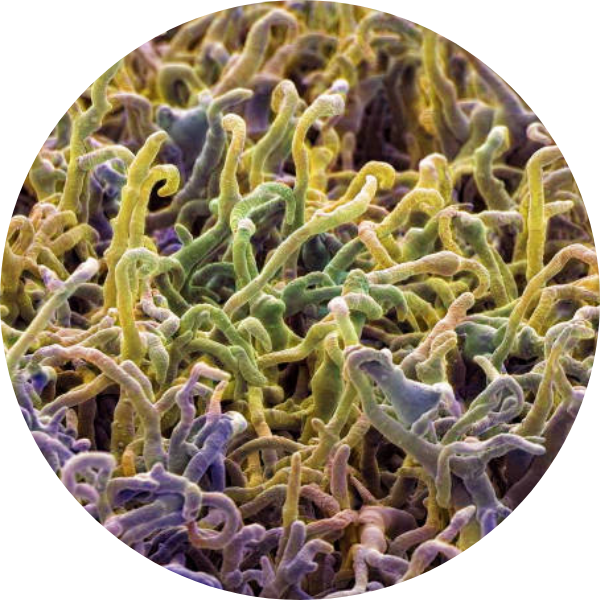
Despite these lingering questions about the metaphorical value of entanglement, when it comes to the “wood wide web,” Sheldrake offers many critiques of the network analogy that dominates our understanding of mycorrhizal fungi and their interactions. He describes, overall, how the “wood wide web” has become a metaphorical playground (or minefield, depending on your view) in which social and political aspirations are projected and all manners of biases confirmed. Sheldrake points to a vast range of ways shared mycorrhizal networks have been conceived, noting how all fall short: “Are we dealing with a superorganism? A metropolis? A living Internet? Nursery schools for trees? Socialism in the soil? Deregulated markets of late capitalism, with fungi jostling on the trading floor of a forest stock exchange? Or maybe it’s fungal feudalism, with mycorrhizal overlords presiding over the lives of their plant laborers for their own ultimate benefit? All are problematic. The questions raised by wood wide webs range further than these limited casts of characters allow” (172).
That it is difficult to even describe mycorrhizal fungi without using the term “network,” though, speaks to the dominance this metaphor has over the others Sheldrake lists above and over our understanding. In many ways, the analogy is built into our knowledge and perception of what is happening in the relationships between fungi and plants. Sheldrake takes particular care to highlight the problems with this network analogy of the “wood wide web,” arguing, in one instance, that it encourages a distorting, “plant-centric” view of mycorrhizal fungi as passive mediators and trees or plants as dominant actors: “The language of the wood wide web … is a metaphor that tugs us into plant-centrism by implying that plants are equivalent to the web pages, or nodes, in the network, and fungi are the hyperlinks joining the nodes to one another. In the language of the hardware that comprises the Internet, plants are the routers and fungi are the cables. In fact, fungi are far from being passive cables” (160).
Fungi, Sheldrake insists, have lives of their own: “it’s a small point that makes a big difference. Everything changes when we see fungi as active participants” (161). Not only does the mycorrhizal fungi/network analogy of the “wood wide web” transform fungi from active to passive participants, but it also implies a kind of fungal uniformity that doesn’t exist. As Sheldrake explains, “the idea that there is a single kind of wood wide web is misleading. Fungi make entangled webs whether or not they link plants together. Shared mycorrhizal networks are just a special case – fungal networks in which plants find themselves entangled” (161). Moreover, Sheldrake implies that the network analogy has led to utopian conceptions of “wood wide webs,” encouraging us to see them as “places of caring, sharing, and mutual aid through which plants can free themselves from the rigid hierarchies of competition for resources.” For him, these conceptions directly echo “the starry-eyed fantasies of the Internet, proclaimed in the fervor of the 1990s to be an escape route from the rigid power structures of the twentieth century and an entrance into a digital utopia” (162). Fungi, like all ecosystems and human societies, “are rarely so one-dimensional,” which is to say, they are never this one-dimensional.
For Sheldrake, then, the challenge in the case of the mycorrhizal fungi/network analogy is to release, or estrange, ourselves from the stranglehold that it has over us. Ultimately, his view is in keeping with the caution that Gilbert expresses about the over-reliance on conventional metaphors in science, that they may get the message out but that they ultimately damage science and public scientific knowledge along the way. As Gilbert warns, metaphors like the “wood wide web” can “lead people to believe that things are happening that really are not happening, and that is ultimately damaging to science more broadly and to the public understanding and appreciation of what really is awesome about what fungi are doing.” Where Sheldrake may diverge again, though, is in his final musings that aspire to a release from not just network metaphors but all metaphors:
“Are we able to release ourselves from these metaphors, think outside the skull, and learn to talk about wood wide webs without leaning on one of our well-worn human totems? Are we able to let shared mycorrhizal networks be questions, rather than answers known in advance? … Are we able to stand back, look at the system, and let the polyphonic swarms of plants and fungi and bacteria that make up our homes and our worlds be themselves, and quite unlike anything else? What would that do to our minds?”
While an important series of reminders – to not rush to answers, to not always make what is different, the same – this final gesture is also steeped in a different utopian fantasy of escaping what makes us human, an impossible desire to be free from language, representation, metaphor, and analogy all together. As Hannah Cole reminds us, to suggest that it might be possible to “get outside of human perspective” is a “false promise … we can only center and understand fungi using our own human apparatuses and ways of knowing.” In other words, we can’t get “outside” of our “skulls,” no matter how much we might want to. Perhaps the aim is for more ethical attempts at analogies or comparisons, not no attempts at all, as we stand back and look at this world we’re trying to both marvel at and understand.
Until next time,
– Laura
THI Deep Read Faculty Lead
Joining the Community Conversation
What do you think about Sheldrake’s final suggestion that we might be able to free ourselves from analogies and metaphors as we attempt to appreciate and understand the natural world and its processes? Do you think this is possible, or do you find Cole’s claim about the impossibility of escaping human ways of knowing to ring true? Even if we may sympathize with Sheldrake, what would freeing ourselves from language look like, and what would it accomplish?
How did you understand Sheldrake’s take on “the wood wide web” when you were reading this chapter? Did you pick up on his critique of the network analogy and how it is applied to mycorrhizal fungi? What do you think about this critique? Do you feel that we rely too heavily on network models to understand the world? Why might this be the case?
In thinking about Greg Gilbert’s comments on the overreliance of conventional metaphors in science, did you find this to be the case in these chapters of Entangled Life? Are there other areas in which metaphors inhibit scientific understanding, as he suggests? What do you think about his interesting claim that, overall, Sheldrake’s controlling metaphor of “entanglement” may lead us to focus more on “wonder” than all of the things we do know about fungi and the natural world?
When it comes to the “zombie” fungi/magic mushroom analogy, do you feel that this comparison works to communicate what’s at stake in our relationship to psilocybin and its effects? Was Sheldrake overly optimistic about psilocybin’s benefits? What is your take on the “dark sides” of psychedelics that we raise here? Alternatively, what do you think about the tensions that Ben Breen finds interesting in psychedelic science?
Finally, what is your view on Ben Breen and Hannah Cole’s suggestions that the fungal view that dominates Entangled Life may not be enough? What might be lost if we leave out other mind-altering organisms when discussing psychedelic fungi? What do we gain by including historical and political perspectives when it comes to using terms like “zombie” in the “zombie” fungi/magic mushroom analogy? Why do you think the kind of etymology Cole calls for is missing in this chapter of the book and what are the effects of its absence?
We’d love to hear your thoughts and perspectives on these questions and more below!