Undergraduate Profile: Sofi Di Cesare-Bystrowicz
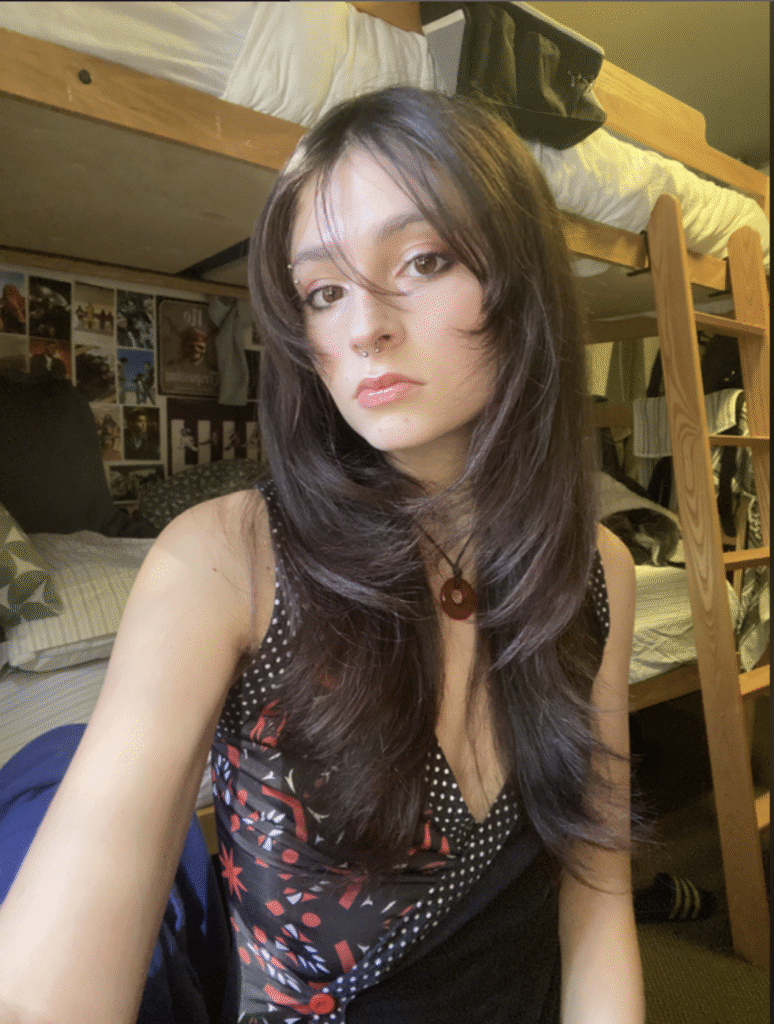
Sofi Di Cesare-Bystrowicz is a sophomore double-majoring in Sociology and History, and a 2025-26 THI Undergraduate Research Fellow and 2025-26 Humanities EXPLORE Fellow. Sofi’s project for her THI Fellowship examines the 19th century Alta California’s Mission System through two historical female figures: Eulalia Perez and Apolinaria Lorenzana. As a Humanities EXPLORE Fellow, she is working with Dr. Grace Delgado on BORDER FUTURES, an archival research project that examines and re-imagines the U.S.-Mexico border. For both projects, Sofi traveled to Southern California to conduct archival research at The Huntington Library and the San Diego History Center archives. We recently caught up with Sofi to learn more about her project, BORDER FUTURES, and her time in the archives!
Hi Sofi! Thanks for chatting with us. To begin, can you tell us a little bit about yourself and your research project for the THI Undergraduate Research Fellowship?
Hi there! I’m Sofi, a second year majoring in Sociology and History. I enjoy reading, crocheting, and “junk-journaling,” where I collect things typically discarded and collage them into something new! With support from the THI Undergraduate Research Fellowship, I’m studying 19th century Alta California’s Mission System through two historical characters: Eulalia Perez and Apolinaria Lorenzana. With my research, I hope to expand discussions on symbolic borders at the intersection of race and gender, and how they facilitate state making and their legislated borders.
What drew you to this research? Why do you think it is important to examine the role of women like Eulalia Pérez in the California missions (and perhaps other Spanish missions in the U.S.)?

While there’s oftentimes discussion about how the Fathers of Missions and the systems themselves have influenced the state borders and societal contentions of today, seldom is there any space to see women’s roles, not as passive, but as agents of the world we’ve inherited. With women like Eulalia Perez and Apolinaria Lorenzana, we get this unique vantage point to see how women in power played into the Missions of California. In their experiences, not only do they attain a means of mobility inaccessible to most contemporary women, but it comes with a price of cultural separation and the surveillance and ownership of people as well as their land. Even then, this did not exempt from the same treatment their system played into—displacement. This isn’t to say this should be the only lens to look at this historical period through, but one that is vital and should be in the conversation when discussing California’s history.
I understand you conducted archival research at the Huntington Beach Library and the San Diego Archives for this project. We’d love to hear about your time in the archives! What kind of documents were you looking at? Were there any specific materials or texts that stood out to you in particular?

Attending archives was revolutionary for me as a History major. Though it was initially difficult to schedule a visit, once there, they were nothing but the greatest help. I gained access to maps nearly two centuries old, land grants, photocards, and interviews. Obtaining a rapport with the archivist was also incredibly vital for my research, as they’d recommend other centers and sites to research for my specific topics. One of the most notable pieces I got to see was at the San Diego Historical Center—an 1840 map of Jamacho Rancho designated for Apolinaria Lorenzana. Seeing these materials and layers of paper in-person – some wilted and others well-preserved – as well as the use of the masculine “Apolinario” to refer to Apolinaria – reminded me of the important work historians and archivists do to keep easily forgotten histories alive.
You write in your project proposal that studying history entails reading archives “with equal consideration to what is omitted as well as what has been preserved.” I’m curious what your approach is to understanding and identifying what is unaccounted for or absent in the archive?

While archives are essential and incredibly important, it’s imperative to understand they are not neutral. Why documents are preserved to begin with is related to power, and why there’s so little material from certain communities is about power, too. So when entering archives, you have to consider who is in the margins of these conversations, or not even in them at all. It’s to consider what folktales tell us about those erased. For example, in the interviews by Thomas Savage, there was a power dynamic occurring at the time of their documentation. Savage was there to understand their roles in the Mission System, foremost, and then about their individual lives. Both having had power at the Missions, their retelling of their experiences is biased through the lens of someone stratified, not marginalized. This is one way in which I had to consider what was being omitted on top of what was being said, and how the two influence each other.
You are also currently working with History Professor Grace Peña Delgado as a Humanities EXPLORE Fellow on her project “BORDER FUTURES: Undergraduates Reimagining the US-Mexico Boundary through Film, Research, and Community-Humanitarian Engagement”. Can you talk some about this project and what your main responsibilities are? What does your collaboration with the team look like? And how is this experience informing the research you are conducting for your own project?

With my team, which includes Dr. Delgado and fellow undergraduate researchers Phoebe Rettberg, and Andrei Lynch, we are all assigned specific roles to understand the realization of today’s U.S-Mexican Border—one tainted with empire, settler colonialism, and the symbolic borders that started it all. My focus has been on collecting and analyzing material from the 19th century in Alta California. I’ve assisted in organizing archival trips, documents of information, and saved archives. Presently, I have been the only person to attend the San Diego Historical Center, so all archives gathered there were from me. Though, sincerely, the work the EXPLORE Team has been able to gather was through great levels of collaboration and communication. For my own project, being with the team allows me to better work in group settings and delineating work, which translates to contacting and organizing with archivists. It has also helped me think about how to organize my research and what is most useful. I’ve found that these opportunities from THI and the Humanities EXPLORE program are symbiotic in the ways they have each supported my learning and research contributions.
I understand that you will be continuing this research independently next year. To end, can you share with us your next steps and goals for the upcoming 2026-27 Academic Year?
As for my next steps in my research, it’s to attend more special collections to gain access to further materials. In June 2026, I will visit the Autry Collection, the Huntington Library, and UCLA with Dr. Delgado and my Humanities EXPLORE team. I also hope to visit the Bancroft library, as well, to see Eulalia Perez and Apolinaria Lorenzana’s interviews in person. I aim to reach out to even more archivists on their collections, and synthesize all this material towards what my research aims to expand on—symbolic borders. By the end, I hope to have a well organized, strong, and innovative research project.
Banner image: Map of the Rancho San Pasqual Plantation, circa 1870. Image courtesy of Wikimedia Commons.

The Humanities Institute funds and leads the THI Undergraduate Research Fellowship program.
The Humanities EXPLORE program is led by the Humanities Division with strategic support from the Humanities Institute, and is funded by the Mellon Foundation, The Helen and Will Webster Foundation, the Humanities Division, The Humanities Institute, and private donors.