
Graduate Profile: Richard Wang
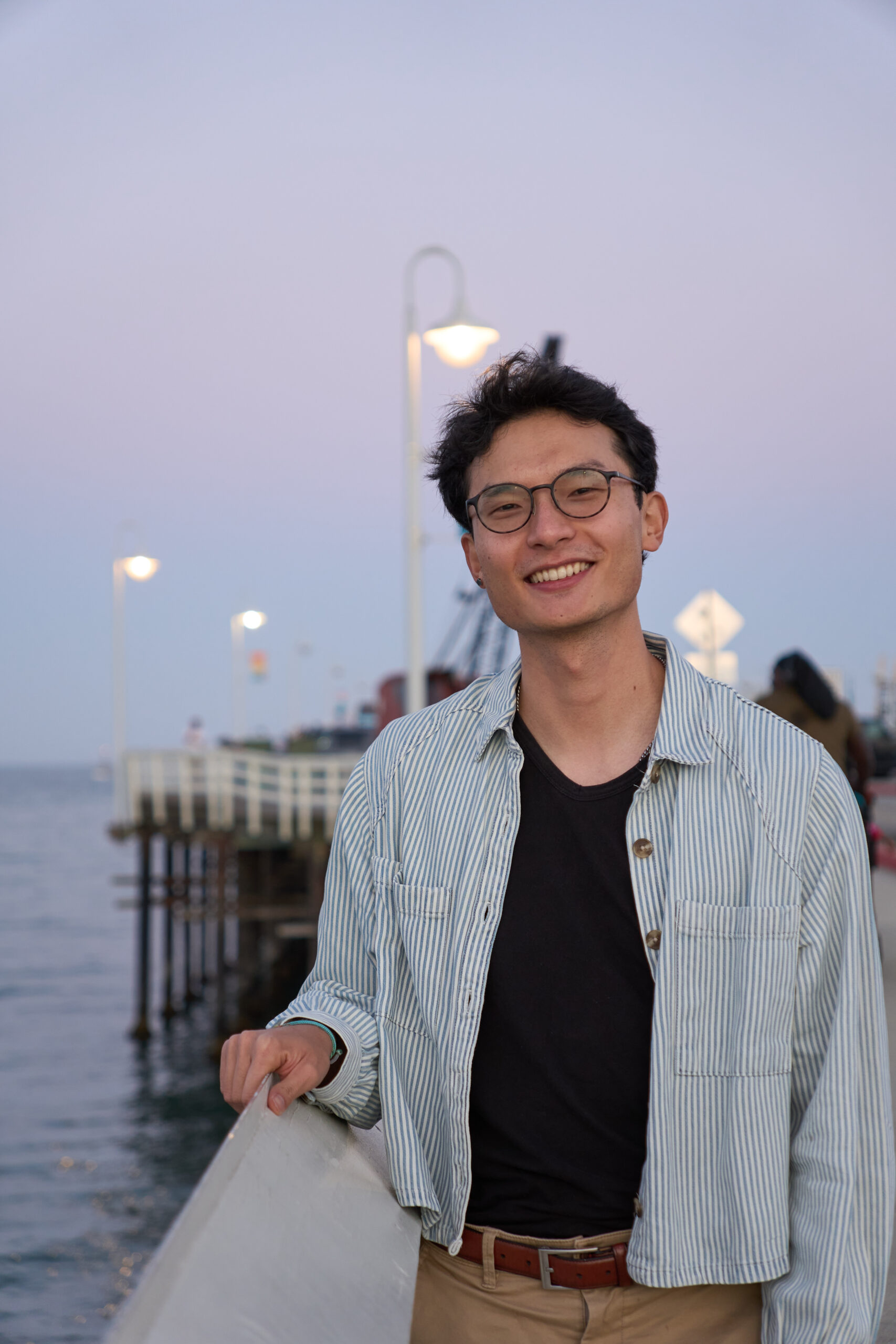
Richard Wang is a fifth-year PhD Candidate in the Linguistics Department and a 2026 THI Summer Dissertation Fellow. In addition, Richard received a 2026 THI Public Fellowship with the Living Tongues Institute for Endangered Languages. Richard’s research examines the phonetics and phonology of tonal languages, especially Beijing Mandarin, employing both computational linguistics and fieldwork in China with language speakers. We recently caught up with Richard to talk with him about his research and what it was like to partner with an organization dedicated to language survival.
Hi Richard! Thanks for chatting with us. To begin, can you give us a brief overview of your current research interests?
My research sits at the intersection of phonetics, phonology, and computational linguistics, with a focus on tonal languages. I’m interested in how sound variation in natural speech — especially variation that emerges in fast or casual speech — is structured by the mind, and how that structure can be captured by large-scale speech models. My dissertation work centers on Beijing Mandarin, where I’m investigating whether certain consonantal reductions are best understood as mechanical byproducts of articulation or as rule-governed patterns that speakers internalize as part of their phonological grammar. Alongside this, I work on low-resource and endangered languages, where I use computational tools to help communities document, transcribe, and analyze their own speech. The through-line across both strands is a commitment to the idea that the big questions in linguistics — about universals, about mental grammar, about how sound becomes meaning — should be asked of all languages, not just the well-studied ones.
This summer you were a 2026 THI Public Fellow with the Living Tongues Institute for Endangered Languages. This sounds like a fascinating project. Can you provide us with an overview of the organization and what you were doing? What was your experience like as a Public Fellow with the Living Tongues Institute and how has this scholarship informed your dissertation as it has developed?
The Living Tongues Institute for Endangered Languages is a nonprofit organization dedicated to documenting and revitalizing endangered languages around the world, primarily through collaborations with speaker communities. Their work spans fieldwork, language technology, and public-facing education, and they’ve been particularly active in South Asia and Northeast India, where many of the languages I study are spoken.
As a Public Fellow, I worked on adapting Omnilingual ASR, an open-source multilingual automatic speech recognition system, to Ho and Santali, two Munda languages of eastern India, in collaboration with community members and linguists who have been recording and transcribing these languages for years. This meant building pipelines to process existing recordings, evaluating how well state-of-the-art ASR models perform on these languages, and — crucially — working with speakers and community linguists to make sure the outputs were useful to them, not just to the research community.
The experience shaped my dissertation in two important ways. First, it grounded my work in the practical realities of language documentation: recordings are noisy, orthographies are inconsistent, and community needs rarely align neatly with research agendas. Second, it pushed me to think harder about what “accuracy” means when the goal isn’t just a benchmark score but a usable tool for a community. A 60% broad phoneme accuracy might look unremarkable in a paper, but if it saves a documentation team hundreds of hours of manual transcription, it matters. That reframing — from what can the model do to what does the community need it to do — has become central to how I think about my own modeling work.
We’d love for you to also share more about the writing you’ve been doing during your THI Summer 2026 Dissertation Fellowship. How has this opportunity supported you? Will you tell us about a particular book you’ve written about or a theorist whose work has shaped your thinking this summer?
The Dissertation Fellowship gave me extended, uninterrupted time to write — something rare in graduate school. I used it to draft several dissertation chapters, particularly the sections where I move from raw phonetic measurements to phonological argumentation.
The work that shaped my thinking most this summer is the recent literature on self-supervised speech models and their relationship to phonology. Papers on wav2vec 2.0 and HuBERT have shown that models trained on raw audio alone — no phonetic labels — nonetheless learn internal representations that align surprisingly well with phonological categories. This raises a genuinely new question: what does it mean for a model to “know” a phonological rule? Is the structure a self-supervised model learns anything like what a human speaker has, or is it a statistical shadow of phonology rather than phonology itself?
I’ve been thinking through this alongside the Omnilingual ASR toolkit, which I’ve been using to transcribe low-resource languages this summer. Omnilingual covers 1,600+ languages — including Ho and Santali, two Munda languages that have never had a large-scale ASR system before. The model has no hand-built grammar for these languages; it learned something from raw audio that lets it make predictions about sounds it has never seen. Whether that “something” is a grammar in any meaningful sense is exactly the kind of question computational phonology is now in a position to ask.
Working with these tools has also sharpened my thinking about evaluation. When we say a model gets 60% phoneme accuracy, what are we actually measuring? Much of the apparent error turns out to be notation differences — the model writes ɑ where the human writes a — rather than genuine recognition failures. Untangling those layers has become central to my dissertation, because the answer determines whether we conclude ASR models are “almost there” for a language, or still very far away.
Together, these strands frame my dissertation’s central argument: that the study of sound variation is simultaneously a study of grammar and of the computational systems we build to model it — and that the two are more entangled than we usually admit.

You analyze language data using large-scale models, but you also record individual speakers. For example, as in your planned travel to Beijing. How does that one-on-one work inform your larger-scale modeling and findings?
The fieldwork and the modeling feed each other in ways that are easy to miss if you only look at one side. When I sit with a speaker and record them, I’m not just collecting data — I’m hearing the kinds of variation that a model trained on read speech will never see. A speaker who reduces a consonant in fast speech, or who produces a vowel that sits between two of my predefined categories, is telling me something about the space of possible variation in the language. That space is what my models need to capture.
Conversely, the models help me ask questions I couldn’t ask from fieldwork alone. When a model trained on thousands of speakers produces a certain kind of error on one speaker’s data, that error is informative — it points to something about the acoustics or the phonology that the model hasn’t learned. So the cycle is: fieldwork reveals variation → models formalize that variation → model failures reveal what’s still missing → fieldwork refines the picture. Neither side is complete without the other.
My planned travel to Beijing is an extension of this. I want to record speakers across a range of speech styles — careful, casual, fast — so that I can test whether the patterns my models have learned hold up in the kinds of natural speech that actually matter for understanding phonological grammar.

Some would say that Linguistics is the most “science-y” of the Humanities. And yet you study language in a way that struck us as similar in certain ways to the work of poets that attend to sound at the level of the syllable. Would you say your project is more philosophical (e.g. the question of whether the consonantal variation you study in Beijing Mandarin is “a mechanical byproduct of fast speech or a rule-governed part of our mental grammar”) or more sociological – that is, more interested in the implications of your findings for communities of language speakers? Or something in between – such as the importance of more languages informing the big questions linguistics is asking?
I love this framing — and I think the honest answer is that it’s all three, and that pretending otherwise would miss what makes linguistics interesting.
It’s philosophical in that the central question of my dissertation is a question about the mind: when a speaker reduces a consonant in fast speech, is that reduction a mechanical consequence of moving the articulators quickly, or is it a rule that the speaker’s grammar knows about? That’s a question about mental representation, and it’s been asked in one form or another since at least the Sanskrit grammarians.
It’s sociological in that the answers to those questions matter differently depending on who’s asking. For a community documenting an endangered language, whether a variant is “a rule” or “a slip” can determine whether it gets written down, taught to children, or dismissed as noise. The categories linguists use have consequences for the communities whose languages they describe.
And it’s poetic — or at least aesthetically attentive — in that the phenomena I study are things you can hear. A reduced consonant, a lengthened vowel, a change in the timing of a gesture — these aren’t abstract symbols; they’re events in a body, unfolding in time. I think linguists sometimes forget that, and I think poets rarely do. The best linguistic work I know has something of the poet’s ear in it: an attention to the specific texture of a sound, not just its category.
So: something in between, and something more than the sum. I think the most interesting questions in linguistics are the ones that can’t be answered by any single discipline — the ones that require you to hold the philosophy, the sociology, and the sound itself together, all at once.
Finally, what’s a favorite discovery since you’ve been at UCSC?
Bouldering. I signed up for a beginner top-roping class through Adventure Rec about two years ago, and after that started bouldering on my own — I haven’t stopped since. It trains your whole body in a way nothing else does: fingers, core, legs, balance, all at once, with no way to muscle through a problem. The most fun part is working out the beta — the sequence of moves that solves a problem. Two people can climb the same route completely differently, and there’s always someone at the gym willing to trade ideas. Santa Cruz turns out to be a great place for it, with a real community of climbers both on campus and at the local gyms — it’s been one of the easiest ways to meet people outside my department. When a model is misbehaving, or a chapter isn’t working, an hour at the wall does more for my thinking than another hour at my desk.
Banner: Photo of West Cliff Drive in Santa Cruz at sunset, taken by Richard Wang.