
Announcing 6 new THI Faculty Research Grantees
The Humanities Institute is pleased to announce 6 new THI Faculty Research Grantees. Faculty research grants provide direct support for Humanities faculty research projects during the 2026 calendar year.
This year’s THI Faculty Research Grantees are: Assistant Professor Ariel Chan (Languages and Applied Linguistics), Associate Professor Renée Fox (Literature), Associate Professor Filippo Gianferrari (Literature), Assistant Professor Thiago Mota (History), Associate Professor G.S. Sahota (Literature), and Professor Massimiliano Tomba (History of Consciousness).
See the grantees’ project descriptions below and check our newsletter and website for stories about their research in the year ahead. A list of all THI Fellows is available here.
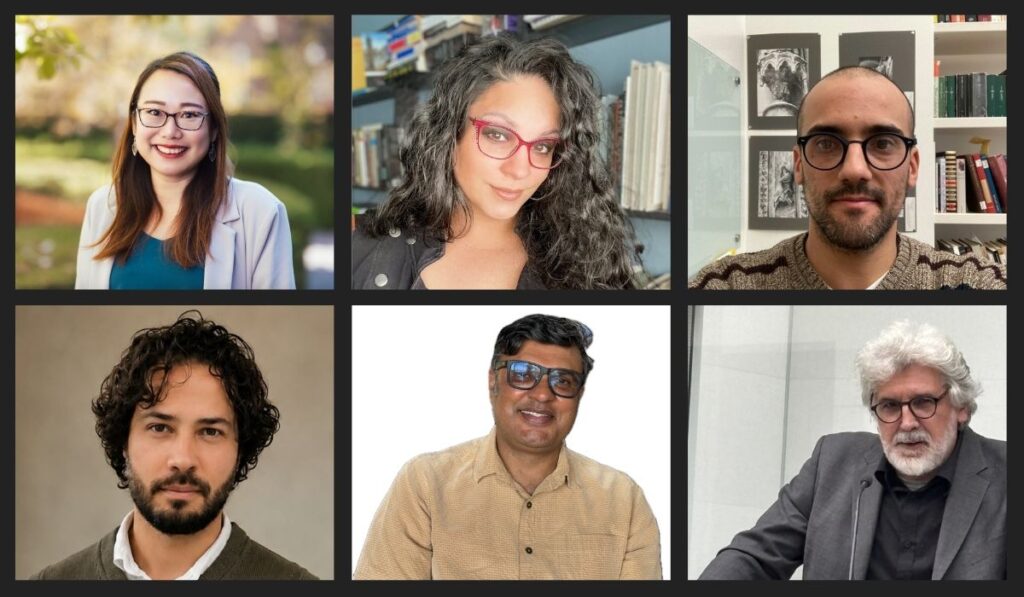
Top row (left to right): Ariel Chan, Renée Fox, Filippo Gianferrari
Bottom row (left to right): Thiago Mota, G.S. Sahota, Massimiliano Tomba
Ariel Chan (Languages and Applied Linguistics): “French-English Homographs and Cross-Linguistic Influence in Bilingual Reading”
This project investigates how French-English bilinguals process words spelled identically in both languages but carrying different meanings (“homographs”), asking how lived linguistic experience and sociocultural background shape meaning-making in real time. By centering individual variation, the study advances a humanistic understanding of multilingualism grounded in the everyday lexicon of bilingual communities.
Renée Fox (Literature): “Irish Literature: History and Myth Since 1798”
This research grant supports my work co-curating an exhibition titled “Irish Literature: History and Myth since 1798,” on display at the New York Historical from September 2026 to January 2027. Including nearly two hundred items from university and private collections in New Jersey and New York, the the exhibition demonstrates that Irish poems, plays, and fictions don’t simply reflect or represent the colonial, revolutionary, and gendered politics that have shaped Ireland as a nation. They have been instrumental in creating and advancing those politics, conjuring the radical possibilities for change that actually make change happen.
Filippo Gianferrari (Literature): “Political Persona: Imagination and Eschatology in the Medieval Mediterranean”
“Political Persona: Imagination and Eschatology in the Medieval Mediterranean” examines how late-medieval vernacular writers responded to catastrophic events — including the Black Death and the fall of Constantinople — by drawing on Averroean and Maimonidean psychological theories to develop innovative visions of political community. Tracing this “political anthropology” through poets and intellectuals such as Dante, Boccaccio, and William Langland, the book argues that philosophical debates over the soul, intellect, and embodiment shaped lay eschatological thinking and grounded hopes for salvation in concrete practices of social care.
Thiago Mota (African History): “Material Islam: Objects of Faith, Religious Performance, and Social Meanings in West Africa”
This project examines how Islamic material culture in West Africa has been collected, interpreted, and represented within museum institutions, with a particular focus on Guinea-Bissau. Its central aim is to investigate how museums have shaped what counts as “Islamic heritage” and, in doing so, to reveal the enduring influence of colonial epistemologies on the representation of African Islam. While nearly half of Africa’s population is Muslim, Islam remains marginal in both popular and scholarly narratives of the continent. This project addresses that gap by foregrounding the material and intellectual traditions of West African Muslim communities and interrogating how these traditions have been reframed through processes of musealization.
G.S. Sahota (Literature): “Photography of Unbelonging and Minor Cosmopolitanism: Sikhs, the USA, and the Optical Unconscious”
This project engages with the predicament of belonging for Sikhs as minority subjects, whether in India or in the West, through an analysis of conventions of photographic representation. Focusing on the images of Raghu Rai, Corky Lee, and the possibilities of a distinctly democratic tradition of American photography, this research dilates upon one photograph that captures the imperiled situation of the minority subject vis-à-vis hegemonic norms of ultra-national belonging. By looking closely at this photograph and the situation it captures, the chapter which results from this research concludes with reflections on the “optical unconscious” as opening a pathway toward a minor form of cosmopolitanism.
Massimiliano Tomba (History of Consciousness): “Marx’s Impure Method: Factory Reports and the Return to the Concrete Research”
This project advances a new interpretation of Karl Marx’s method by showing how Capital is shaped not only by conceptual analysis but also by extensive investigations into the concrete conditions of labor. Focusing on the Factory, Children’s, and Public Health Reports, it argues that Marx’s critique emerges from the encounter between theory and the lived realities of exploitation, bodily experience, and resistance. The project contributes to contemporary debates on method, critical theory, and the study of capitalism.