
Week 4: On Fungi and Transformations – An Interview with Donna Haraway
As we follow Sheldrake to the end of Entangled Life and close out our exploration of the book, we continue to probe and search along with him as he takes fungi as his guide to understanding fungal processes and their revelatory effects on the world and our lives. In these final chapters, one key thread that emerges is transformation – both the transformational nature of fungal processes and the transformative effects they can have on living systems and our own perspectives and thinking. In “Radical Mycology,” for instance, Sheldrake explains how fungi, as both composers and decomposers, have evolved to transform crisis into opportunity: “their ability to cling on – and often flourish – through periods of catastrophic change is one of their defining characteristics” (176). He details how innovative mycologists like Peter McCoy and emergent businesses like Ecovative Design are attempting to create fungal solutions to pressing technological and ecological problems, such as agricultural waste disposal and the need for alternatives to climate-polluting plastics. While being careful to highlight limitations of the fields, he takes us from mycoremediation to mycofabrication, showing how fungal decomposition is being marshalled to repair contaminated ecosystems and how fungal recomposition is being harnessed to produce everything from leather and batteries to bricks and compostable packing materials. Perhaps it’s become a necessity, he asserts, to forge “new fungal relationships” that transform our relationship to fungi in order to survive and “adjust to life on a damaged planet,” a process that is “less about inventing than remembering” what fungi can do (176).
In “Making Sense of Fungi,” Sheldrake jogs our collective memories to help us recall our historical entanglements with the “transformational power of yeasts,” these fungi that convert grain into beer, grapes into wine, and nectar into mead. Long “personified as a divine energy, spirit, or god,” yeasts are central to human culture, both “makers and breakers of human social orders,” Sheldrake insists. Throughout our history, they have had a role in both supporting existing orders, taking center stage in “ritual feasting and statecraft [and as] a means to pay for labor,” and undermining them, responsible for “dissolving our senses, for wildness and ecstasy” (205). As with all fungal subjects in Entangled Life, this metabolic function of yeasts is also symbolic. Yeasts are not only biologically transformative but also perceptually transformative, leading us to reflect on the limits of our categories as well as how categories determine how and what we know. Sheldrake invokes UC Santa Cruz’s own Donna Haraway, Distinguished Professor Emerita of History of Consciousness, in his epigraph to this chapter. He cites her 2016 book Staying with the Trouble to suggest that “making sense of fungi” is as much about us as them: “It matters which stories tell stories, which concepts think concepts … which systems systematize systems,” he quotes (202). As Sheldrake is signaling here, his attention throughout Entangled Life to the determining character of narrative, concepts, and categories in science and his commitment to thinking more carefully about them is deeply indebted to Haraway’s groundbreaking, interdisciplinary work, which began in 1976 when she published her first book, Crystals, Fabrics, and Fields: Metaphors of Organicism in Twentieth-Century Developmental Biology, a study that took on the field of developmental biology to show how dominant scientific metaphors, especially of embryos, influence our scientific paradigms and understanding.
I spoke with Donna about her work, how it resonates with Sheldrake’s Entangled Life, and her excitement at finding a kindred spirit who approaches understanding fungi as she does biology (just one of her many interests). Here is an edited excerpt of our conversation in which we range from these subjects and the transformational character of fungi to radical methods of inquiry and back again. I hope you will enjoy our fungi-inspired meanderings and learn as much from Donna’s many insights as I did!

On Fungi, Categorical Breakdown, and Entangled Thinking – A Deep Read Conversation with Donna Haraway
Laura: There have been tomes written about you and your work as well as its far-ranging impact and importance. I could certainly cite and synthesize these for the Deep Read community, but it would be much more interesting to hear from you! Tell me, how would you describe your work, interests, research, and career overall.
Donna: My work has always been about a kind of resistance to the way categories fix things, and looking for the way categories can become more like verbs, more like things in action, things in motion. The connectivity of categories has always interested me, too. While I have the language to describe these interests now, I didn’t necessarily have that language at the beginning of my academic career. For example, as an undergraduate at Colorado College, I was a triple major in zoology, philosophy, and literature, and I didn’t see any conflict among these three ways of being in the world. There are plenty of differences, but I found that all of them were just explosions, like the kind of candy that has flavor bursts when you’re eating it. I found these different ways of knowing the world intellectual, but also very physical. Since college, I’ve been deeply interested in process philosophy and in continental phenomenology and existentialism.
If I then think about the work I did in graduate school as a biologist, the dissertation I ended up writing was my first book, Crystals, Fabrics, and Fields, which is about how metaphors shape embryos. My interdisciplinary work as an undergraduate continued with me doing an interdisciplinary PhD in biology – with philosophy, history of science, and developmental biology – looking at the ways researchers’ commitments to metaphor, to the way they think the world is built, sometimes conscious and sometimes not, shaped their work in the lab or in the field. I became so much more interested in the intersections of biology and culture and in the ways that linguistic and cultural worlds shape biology and vice versa, that the dissertation ended up being about three embryologists across the early 20th century and how their research was shaped by the metaphors they used. And clearly that’s a concern of Sheldrake in Chapter 8, “Making Sense of Fungi,” where he quotes me, but also throughout Entangled Life.
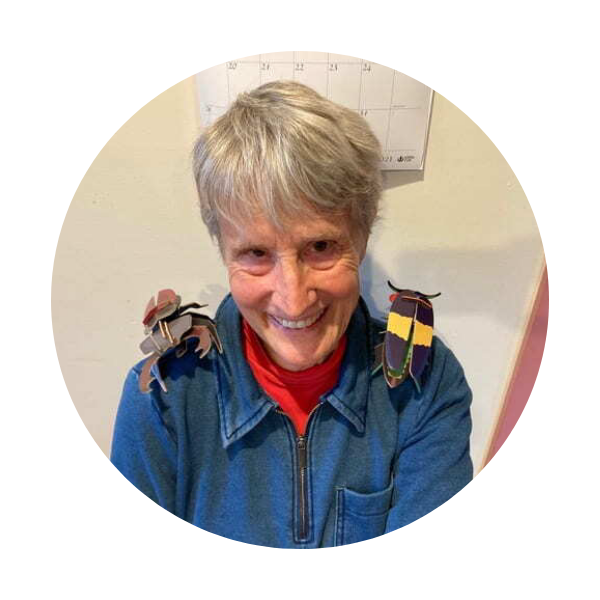
Laura: I’m glad you brought up the book. I’d love to hear what you think about it and what you found interesting when you were reading Entangled Life. I’m also so curious about what it was like to read a book that shares so many of your concerns–like the ones you just mentioned, such as the fixity of categories, the determining character of metaphors, interdisciplinary approaches, etc.
Donna: First, I love the book, and I loved it from the first note. You know, when you go to a concert (let’s say you’re at Kuumbwa), and there’s a trio playing, and you realize right from the first measures that you are in good hands and that you do not need to worry. Or you go to a talk, and you realize from the first few sentences that you can relax, that the speaker is going to play well, knows their instrument, and is making music in a way that allows you to relax. Well, that’s the way I felt about this book. Sheldrake is a good writer. When I was reading, I felt like I was in the hands of a writer who knows his craft. Second, he also clearly knows his subject, fungi, and is acquainted with the biological magnificence of this kingdom in a way that I wasn’t. I came to know fungi much later, because I was animal-centric as a biologist, which was really a horrible thing to be, but I think the book is a real invitation. It invites any reader to join – someone who has eaten mushrooms, avoided eating mushrooms, or even knows nothing about them or fungi. It invites that person into the book, too. And this is partly because Sheldrake has the gift of taking complex concepts and making them concrete. He takes fungi, but then goes to something like the concept of individualism to show how the boundaries of individuality are not fixed and are always not just porous, but interconnected, as if by mycelium.
Laura: I agree. One thing I really liked about Entangled Life, and why I advocated for it being our Deep Read selection this year is that Sheldrake is very particular and rooted in science, but he also abstracts from it to ask big questions, but in a very concrete way. What, for instance, does learning about lichens tell us about individuality? What do fungal webs tell us about consciousness? And he shows time and time again that, if we center fungi, then that changes our understanding of all these pretty conventional notions we have.
Donna: I agree with you. Sheldrake is like a good ethnographer who lets the theoretical work grow out of the material. He is very interested in whether something holds up to evidence, but, again and again, the conceptual apparatus grows from the immersion in the stuff. I love the way he is quite ready to engage the organisms with whom he is doing research, not on whom he is researching.
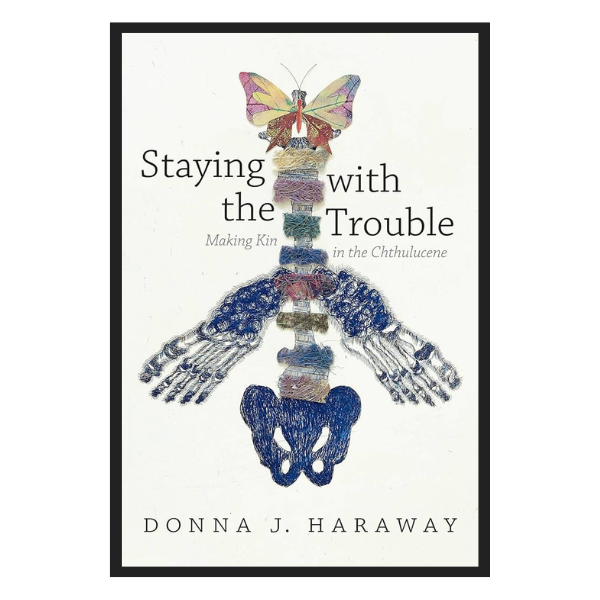
Laura: This reminds me of your discussion in Staying with the Trouble when you talk about learning to “become with” others as a kind of ethical practice and way to live in the present in our particular time of crisis. Would you say Sheldrake’s work and approach is in keeping with yours in this sense?
Donna: Absolutely. I’m continually interested in becoming, and becoming “with others” is acknowledging that entities are never all by themselves. We are always already entangled, entwined with other organisms, which doesn’t mean there aren’t forms of differentiation that provide provisional separation. The history of life on Earth is all about meaningful boundary making and provisional separation, and the biological world is constantly doing that, but I think what too many, mostly western-indebted philosophers, biologists, and political theorists have done is to harden the edges of the boundaries as opposed to focusing on relating. I’m not so interested in units and relations. I’m interested in relating, right? I’m interested in processes, not things, and I think Sheldrake is, too. We see this with yeasts in Chapter 8 and throughout the book; he constantly shows how the fungal world is a process, not a thing.
Laura: Yes, it’s such a key point you’re making; he’s often emphasizing process and also the transformations in perspective that follow when you focus on fungi as complex processes and not things.
Donna: Yes, he’s interested in the way boundaries are always contextual. We see this when he talks about how extraordinarily opportunistic and biodiverse fungi are and when he shows us that mycelial networks and mycelial tips are where the action is—this growing tip that is always extending and always taking in and transforming and putting out chemicals that dissolve a bit of the rock and take up nutrients. And this leads him to consider individuality, that trying to figure out what counts as a genetic individual for a fungus is extremely difficult. As he points out, it’s really kind of a fool’s errand, because when you look at fungi through magnification, you’re watching nuclei flowing through the mycelial tube into the root of the plant. You get these packed mycelial fibers with flowing nuclei, and in a mycelial network, all of those nuclei are not genetically identical, right? You will have, from a genetic point of view, multiple distinct genomes that are in some kind of entangled connectivity that don’t allow you to talk about the individual genome in the way that someone like Richard Dawkins wants to discuss it.
Laura: Interesting. I appreciate so much how Sheldrake reveals that bounded individualism in this sense is a story that is told but is not actually reflective of biological reality.
Donna: Yes, individuality breaks down here. And the point of breakdown can be the most interesting point in an effort to conduct an analysis of a phenomenon, because Sheldrake and I are both interested in analysis. We want to know how something works and why. It reminds me of Bruno Latour, a thinker and friend (we taught each other a lot); both of us were really interested in the way the philosophical phenomenologists said the most interesting point in any system is when it breaks down. Because it’s when the system breaks down that you have a chance to learn something you didn’t already know. And fungi are fabulous organisms to work with, because their job is decomposition, and they decompose material out in the world but also our ideas, as Sheldrake points out.
Laura: I love this way of thinking about fungi’s relationship to our ideas as decompositional, that fungi break them down. He’s interested in this kind of thinking in the Epilogue where he’s talking about decomposition (and decomposing and eating his own book!), but it also seems related to a moment in Chapter 8 when he talks about symbiosis and metaphor. He says it’s often only “with hindsight” that we understand “which metaphors are most helpful” (212). For him, symbiosis is one of these metaphors that are helpful, and he notes that we’ve become more nuanced in our understanding of organisms’ relationships because of this concept. Symbiosis has become more of a question than an answer. I’ll quote here: “Plants and mycorrhizal fungi are no longer thought of as behaving either mutualistically or parasitically. Even in the relationship between a single mycorrhizal fungus and a single plant, give and take is fluid. Instead of a rigid dichotomy, researchers describe a mutualism-to-parasitism continuum. Shared mycorrhizal networks can facilitate cooperation and also competition. Nutrients can move through the soil but so can poisons. The narrative possibilities are richer. We have to shift perspectives and find comfort in – or just endure – uncertainty” (212-13). What do you think about his assertion that we need to transform our perspectives in a way that incorporates uncertainty? Is this a breakdown in the system as you were talking about with mycelial networks and individualism?
Donna: Well, I do think Sheldrake gets pleasure when the narrative possibilities are richer, when the narrative possibilities elaborate. It’s not because he thinks all stories are equally true when he’s trying to figure out why it is that the fungi he studies, mycoheterotrophs like Voyria tenella, have lost their chlorophyll. How do they get their carbon? He actually wants to know how they get their carbon, right? And that’s a very hard problem. And it really matters. I don’t think he’s in love with complexity for complexity’s sake. Of course, complexity and epistemological uncertainty are not the same thing, but they do feed each other. He might be interested in complexity and uncertainty, but he tries to discipline both tendencies, and he thinks some analogies, metaphors, and stories are better than others. And so do I.
For example, I don’t think you can do good biology now unless you understand that the whole notion of the organism is a very difficult one to use these days, because it’s essentially a 19th-century industrial factory concept – an entity that is enclosed by membranes; works by the division of labor; acts like a heat machine; and is involved in production, reproduction, and executive functions. When organisms relate with other organisms with this analogy, they do so through trading networks that are very similar to markets regulated by capitalism. You can’t do good biology in the early 21st century without understanding that the general story is the story of symbiosis, as Sheldrake notes, and that all organisms are really holobionts, which he talks about on page 92 and calls an “assemblage of different organisms that behave as a unit.” We are holobionts, as are lichens. Indeed, as the biologist Scott Gilbert says, “we are all lichens now.” Sheldrake also uses Scott’s work.
To go back to the question of uncertainty, I don’t think he uses the word as a generalization, but I worry about the way it can work as a generalization, one that suggests, well, we’re always just uncertain so why bother trying to decide. I think there are contexts in which you definitely do need to decide, like, where does my flower get its carbon, as I mentioned before. I want uncertainty to have an edge to it, and I think it does have an edge in the way he uses the word. With Sheldrake, we know that scientific knowledge is never finished, never certain, always searching, always ragged.
Laura: I follow you, and I think it’s interesting to think about his uncertainty having an edge. I hadn’t thought about it like that, but it makes sense, especially given that his uncertainty, as we talked about at the beginning, is so rooted in careful scientific research, study, and experience. I wonder if, by way of closing, I could ask one last question. Are there other texts that you’d recommend to readers of Entangled Life that would help us understand the book and its contexts, or extend what we learn from reading Sheldrake?
Donna: Yes, certainly. Scott Gilbert has a new book coming out (the working title is We Are All Lichens: World Making through the Strange Alliance of Science and Religion). I would definitely recommend Anna Tsing’s The Mushroom at the End of the World and Laurie Palmer’s The Lichen Museum. I think Warren Sack’s book The Software Arts belongs on this list. There’s also plenty of fiction I would suggest, N.K. Jemisin’s Broken Earth trilogy and anything by Ursula K. Le Guin. I wrote an introduction to Le Guin’s The Carrier Bag Theory of Fiction, which is a terrific work.
Laura: Thank you so much for all of these suggestions, and thank you for talking with me and engaging with Sheldrake’s work and your own. It’s been fun and enriching.
Donna: It has been, and I’ll say just one last thing, one last thing I appreciate about Sheldrake’s work. He’s very passionate about fungi, and I think it’s important to hold on to passion for the living world in these troubled times.
Closing the Circuit: On Composition and Decomposition
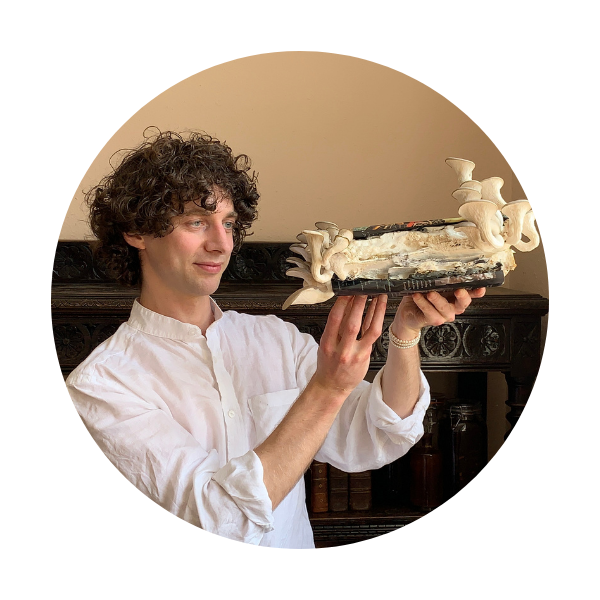
As Haraway points out, one striking thing about Entangled Life is how Sheldrake, in such varied but consistent ways, holds on to and highlights his passion for fungi. In his epilogue to the book, “This Compost,” he even claims that he has more passion for fungi and the questions they raise at the end of his exploration than at the beginning: “There is more pollen on my face than when I began. New whys have fallen on top of old whys. There is a bigger pile [of leaves] to leap into, and it smells just as mysterious as it did at the start. But there is more damp, more space to bury myself, and more to explore” (225). Sheldrake’s entanglements with fungi and their transformational possibilities will deepen and continue, he suggests. For now, though, he must close the loop and end his book, although this is no conventional ending. As Sheldrake begins Entangled Life in an unconventional way, prostrate to mycelium and with his nose in the dirt, so he ends, giving his book, his composition, over to fungal decomposition by seeding it with oyster mushrooms and fermenting some of its pages to make beer. Once the mushrooms sprout and the beer is finished, he will eat, drink, and “close the circuit.” Fungi, he concludes, “make worlds” and “unmake worlds”; his goal is to show us all of the ways we are involved in their transformational cycles of making and unmaking. There are so many “ways to catch [fungi] in the act” and so many ways that they can “catch [us] in the act,” too. Whether we realize it or not, our lives are and will always be entangled with theirs, but isn’t it better, he urges, to be alive to the entanglements, mysteries and all?
-Laura
THI Deep Read Faculty Lead
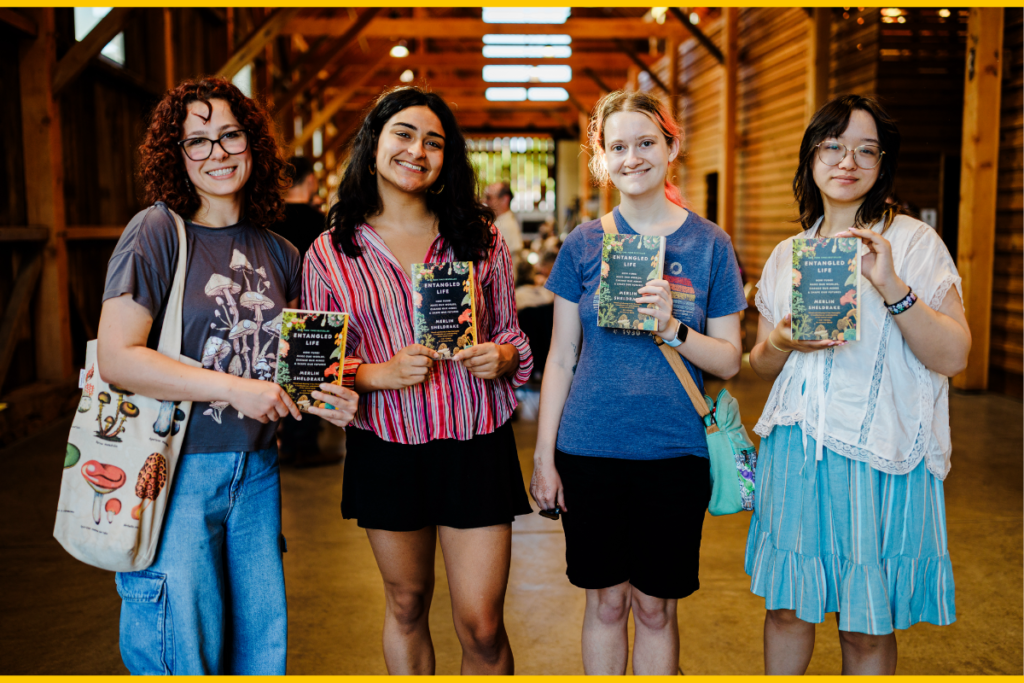
Community Conversations
We’d love to hear your concluding thoughts, reflections, and ideas on our website.
How do you feel about Sheldrake’s final gesture of entanglement when he pledges to eat and drink his book? How does this “close the circuit” of his exploration of fungi exactly? And is the circuit truly closed, or are we just witnessing another transformation here?
What do you think about the various ways fungi transform the natural world and our thinking? Do you feel transformed in any way by reading Entangled Life? Or can you sense possibilities for transformations? How so and in what ways?
How might we continue to be “alive” to fungi, as Sheldrake is urging us to be at the end of Entangled Life and throughout his book? Might Donna Haraway offer some clues in her interview?
What do you think about Haraway’s reflections on the relationship between science and metaphors? Are you seeing the ways that Sheldrake is indebted to her work and perspective? Did you find Sheldrake a kindred spirit, as she did? Why or why not?
It’s been wonderful exploring this book and all of its threads, layers, and dimensions with you. We hope to see you again next year for another Deep Read adventure!